
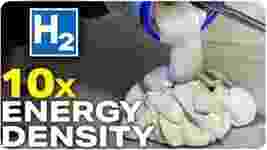
THIS is one of the most remarkable breakthroughs in energy storage, particular for hydrogen. It’s the hydrogen paste from Fraunhofer institute.
Researchers are currently working intensively to find new ways of storing hydrogen. Ammonia and boron nitride, among other substances, play a role here, enabling hydrogen to be bound with up to 90 percent greater energy efficiency. But this paste I am talking about today, is next level.
*https://www.youtube.com/watch?v=PWjwzAiqfXU
таймкоды
00:00:00 Введение в водородную пасту
- Водородная паста — новое достижение в хранении водорода, разработанное Институтом Фраунгофера в Германии.
- Исследователи активно ищут новые способы хранения водорода, включая аммиак и нитрид бора.
- Доктор Якоб Баутон представляет технологию водородной пасты.
00:00:52 Проблемы хранения водорода
- Водород обычно хранится в виде газа под высоким давлением или в жидком виде при очень низких температурах.
- Эти методы сложны и дорогостоящи, что ограничивает мобильность водородных автомобилей.
- Водородная паста может решить проблему транспортировки и хранения водорода.
00:01:51 Процесс производства водородной пасты
- Для производства пасты используется гидрирование порошка магния в реакторе под давлением 6 бар.
- Гидрогенизированный порошок измельчается с эфиром угольной кислоты и солью металла в шаровой мельнице.
- Продукт реакции состоит из гидроксида магния, воды и эфирных компонентов, которые можно переработать.
00:02:49 Преимущества механохимии
- Механохимия использует механическую энергию для запуска химических реакций, что делает процесс экологичным и экономичным.
- Энергетическая паста хранится в герметичных контейнерах и обладает высокой плотностью энергии — 1,9 кВт·ч/л.
- Для высвобождения водорода пасту нужно смешать с водой.
00:03:43 Применение и перспективы
- Грузовикам с пастой не нужно заезжать на заправку, достаточно заменить ёмкость и добавить воды.
- Из 10 кг пасты получается 1 кг водорода, что соответствует выработке 1,6 кВт·ч на килограмм.
- Планируется строительство завода в Брауншвейге для производства 4 тонн пасты в год.
00:04:40 Возможные применения и цена
- Паста подходит для транспортных средств и домашнего использования.
- Институт Фраунгофера планирует сотрудничество с внешними производителями при успешном производстве.
- Окончательная цена пасты пока неизвестна, но цены на энергоносители играют ключевую роль.
00:05:40 Другие исследовательские подходы
- Проект ShipFC изучает хранение водорода в виде аммиака для судов.
- Аммиак требует более низких температур и давлений для хранения по сравнению с чистым водородом.
- Аммиак — отличный энергоноситель для хранения топлива, особенно для судов, которые выбрасывают много загрязняющих веществ.
00:06:36 Использование аммиака и боргидрида натрия
- Аммиак расщепляется на борту на водород и азот, которые подаются в топливный элемент.
- В результате реакции остаются чистая вода и азот.
- Катализатор предотвращает образование токсичных газов.
- Проект H2 ships использует боргидрид натрия для извлечения водорода.
00:07:35 Исследования стабилизаторов
- Продолжаются исследования наиболее подходящего стабилизатора, например, каустической соды.
- Компания «Даймлер Крайслер» использовала каустическую соду в прототипе автомобиля.
- Остаточный материал после реакции можно повторно обогатить водородом.
00:08:32 Метод с нитридом бора
- Нитрид бора используется для эффективного хранения водорода.
- Шаровая мельница на 90% энергоэффективнее традиционных процессов разделения.
- Процесс безопасен и не требует агрессивных химических веществ.
- Порошок можно использовать многократно, без образования отходов.
00:09:29 Проблемы топливных элементов на основе аммиака
- Топливный элемент не преобразует весь водород в энергию.
- Реактор расщепления не может полностью расщепить аммиак.
- Эффективность топливных элементов с аммиаком составляет 51%.
00:10:27 Недостатки боргидрида натрия
- Боргидрид натрия токсичен и дорог в производстве.
- Масштабное использование ограничено высокой ценой.
- Эксперименты с боргидридом натрия не вышли за рамки прототипа.
00:11:20 Сравнение методов хранения водорода
- Водородная паста и нитрид бора не содержат токсичных химикатов.
- Австралийский порошок нитрида бора находится на стадии разработки.
- Новые методы требуют меньше энергии для хранения и транспортировки, но больше для высвобождения водорода.
00:12:20 Будущее водородной энергетики
- Существующие и будущие методы будут сосуществовать.
- Институт Фраунгофера считает, что ни один метод не станет доминирующим.
- Автор планирует снять видео о новой установке в Институте Фраунгофера.
In this video
Chapters
Transcript
0:00
This is one of the most remarkable
0:02
breakthroughs in energy storage
0:04
particular for hydrogen. It’s a hydrogen
0:06
paste from Frownhof Institute in
0:08
Germany. Researchers are currently
0:10
working intensively to find new ways of
0:13
storing hydrogen. Ammonia and boron
0:15
nitride among other substances play a
0:17
role here, enabling hydrogen to be bound
0:19
with up to 90% greater energy
0:22
efficiency. But this paste I’m talking
0:24
about today is next level. We’re going
0:26
to find out exactly what this solution
0:28
looks like. how it works and what is the
0:31
potential of this technology and with
0:33
that welcome to the German science guy.
0:35
I’m Dr. Yakobo and in Germany we say Los
0:38
Gates
0:40
0:41
there’s a lot of talk about hydrogen and
0:43
we have seen some improvement in
0:45
producing it like I showed in one of my
0:47
last videos. However, one of the main
0:49
problems with hydrogen is still its
0:51
transport and storage. Hydrogen is
0:53
either stored as a gas in tanks at very
0:56
high pressure or in liquid form at
0:58
around -250° C. Both are complex and
1:02
expensive processes. Even in car tanks,
1:04
hydrogen requires 700 times atmospheric
1:07
pressure. This is why the tanks of
1:09
hydrogen cars are super large and heavy
1:12
and the energy density advantages over
1:14
lithium batteries are marginal which is
1:16
a problem in terms of mobility. for
1:18
example. However, the use of hydrogen
1:20
paste could change the transport and
1:22
storage problem forever. The technology
1:25
was developed by the Frownhof Institute
1:27
and is considered a promising solution
1:29
for hydrogen transport. [music] To
1:30
produce it, the first step is to
1:32
hydrogenate magnesium powder. So,
1:35
magnesium powder reacts with hydrogen.
1:37
To [music] do this, both substances are
1:39
placed in a special steered reactor at a
1:41
pressure of six bar. It’s like a large
1:44
thermomix under pressure. By the way, is
1:46
Theromix a thing outside of Germany? It
1:48
is this cooking machine and Germans go
1:50
crazy about it. Well, this hydrogen
1:53
Theromix produces magnesium hybrid
1:56
powder. The hydrogenated powder is
1:58
grounded together with carbonic acid and
2:00
metal salt in a agitator ball mill which
2:03
is a very fine mill. This produces a
2:06
homogeneous math with optimal conditions
2:08
for the transport and release of
2:10
hydrogen. The result after the reaction
2:12
is collected in a separated container.
2:15
It consists of magnesium hydroxide,
2:17
water and esester components and can be
2:20
recycled. The primary focus is on
2:22
recycling the magnesium hydroxide which
2:24
is the largest component of the paste.
2:27
It can either be processed and then used
2:29
as a recyclable material in other
2:31
industries or converted back into
2:33
magnesium. This magnesium could then be
2:35
used to produce new paste. It is
2:37
therefore a cycle. The paste is
2:39
manufactured using mechanochemistry.
2:41
Mechanochemistry uses mechanical energy
2:44
to trigger chemical reactions. Ball
2:46
mills are used for this purpose among
2:48
other things. This is a rotating drum
2:50
containing small stainless steel balls.
2:52
Rotation and vibration generate
2:54
mechanical energy which then activates
2:56
chemical reactions. The method is
2:58
considered particularly sustainable and
3:01
cost effective as it does not use
3:03
solvents, consumes little energy and
3:05
emits low levels of CO2. Australia has
3:08
also recently seen a mechanochemical
3:10
breakthrough that came as quite a
3:11
[music] surprise, but more on this in a
3:13
moment. To get the most out of the power
3:16
paste, it is stored in an airtight and
3:18
moisture proof container. This allows it
3:20
to be stored for several months or even
3:22
years. And powerpaste has an enormous
3:25
energy density of 1.9 kW hours per
3:28
liter. That is 10 times the capacity of
3:31
lithium ion batteries. This means that
3:33
for the same mass, hydrogen paste stores
3:36
10 times more energy. To release the
3:39
hydrogen from the paste, you simply have
3:41
to combine it with water. This means
3:43
that a truck using the paste would not
3:45
need to visit a filling station, but
3:47
simply change this bottle and add water.
3:50
The really amazing thing is that half of
3:52
the hydrogen produced is created by the
3:55
added water. So even more energy without
3:58
more storage capacity. 10 kg of power
4:01
paste yield 1 kg of hydrogen. That
4:04
corresponds to an output of 1.6 kwatt
4:07
hour per kilogram. So as you can see,
4:09
I’m really excited about this technology
4:11
because it is it is amazing. It will
4:13
really change how we can use hydrogen.
4:16
So what is going on there right now? A
4:18
large power pace production plant was
4:20
supposed to go into operation already
4:22
and I’ve been following this closely of
4:23
course and I also talked to the
4:25
frownhoer institute the institute behind
4:28
it. So the goal is 4 tons of power paste
4:31
should be produced per year in Brownike,
4:34
a city in Germany where the facility is
4:36
located. That’s a total of 6,400 kwatt
4:39
hours of energy. An average electric car
4:42
could cycle the globe once with that.
4:44
But and this is more important today,
4:46
power pace is not only particular
4:48
suitable for various small vehicles, but
4:50
also for households. If the production
4:53
facility runs successfully, the FRA
4:55
Institute wants to take the next step of
4:58
working with external producers to
5:00
manufacture power paste on a large
5:01
scale. Of course, there’s one important
5:03
point we have to talk about and it is
5:04
the price. But the final price of power
5:07
paste is still unclear. But what we
5:09
already know is that the energy prices
5:11
play a major role here. Until the
5:13
production facility opens, however, work
5:15
is also being done on other possible
5:17
applications for power pays. Together
5:18
with a company in Greenland, the
5:20
Farenhoofer Institute has developed an
5:22
emergency power generator for power
5:24
outages. [music] In it, a fuel cell
5:26
generates energy from hydrogen. The
5:28
hydrogen comes from the paste which is
5:30
stored in cartridges and fed into the
5:33
cell from there. The reaction between
5:35
the power paste and water can be
5:36
activated or deactivated simply by
5:39
pressing a button. But in addition to
5:41
the paste, there are other research
5:42
approaches to storing hydrogen that I
5:45
really want to mention. One
5:46
international research project working
5:48
on this is ship FC. This is because
5:50
ships emit enormous amounts of
5:52
pollutants into the air. Global shipping
5:55
emitted 833 million tons of CO2 in 2021.
5:59
This is more CO2 than the entire road
6:02
traffic in Europe emits. That is why
6:04
researchers are working intensively on
6:06
alternative emissionfree fuels. Ship FC
6:09
has set itself a goal of storing
6:10
hydrogen in the form of ammonia. Ammonia
6:13
consists mainly of two substances,
6:15
nitrogen and [music] hydrogen. But
6:17
unlike pure hydrogen, which must be
6:19
stored and transported at either minus
6:21
253° C or 700 bar, ammonia only requires
6:26
a temperature of — 33° or a pressure of
6:29
9 bar at + 20°. Ammonia is therefore a
6:33
great energy storage medium for the
6:34
actual fuel. To obtain this, ammonia is
6:37
first split into hydrogen and nitrogen
6:39
on board and then fed into a fuel cell
6:41
that generates electricity. The hydrogen
6:44
is consumed, leaving pure water and
6:46
nitrogen behind. A catalyst prevents
6:48
toxic gases from being produced and
6:51
prevents hydrogen and ammonia residues
6:53
from entering the environment. This
6:55
technology should also make long voyages
6:57
with large ships reliably possible. And
6:59
actually, there are already some
7:00
results. There are already some ships
7:02
using ammonia. But there are also other
7:05
options that are exciting. A second
7:06
option is to extract hydrogen from
7:09
sodium boroh hydride powder. This is a
7:11
focus of the H2 ships project in the Neo
7:14
orbits. The 20 m long ferry is currently
7:17
being built in Amsterdam and is set to
7:19
become the first ship to run on a solid
7:21
hydrogen compound next year. For the
7:24
drive system, the sodium boroh hydride
7:26
is first mixed with high purity water
7:28
and a stabilizer. The mixture is then
7:31
passed through a catalyst releasing the
7:33
hydrogen. The fuel cell is then used
7:35
again. Research is still ongoing to
7:37
determine which stabilizer is the most
7:39
suitable. One possibility would be
7:41
costic soda. Da crisis already operated
7:44
a prototype car in the early 2000s using
7:47
costic soda as a stabilizer and sodium
7:50
borohhydride as a fuel. The stabilizer
7:53
is consumed in the reaction leaving
7:55
behind sodium metaborate. This can be
7:58
enriched with hydrogen again and in this
8:00
way the residual material is recycled
8:02
into a new fuel after the reaction. But
8:05
that’s not all. There’s another
8:06
promising method of transporting
8:08
hydrogen and it has been discovered in
8:10
Australia quite by accident. Researchers
8:12
were actually looking for an alternative
8:15
to petroleum distillation. Instead they
8:17
discovered the latest process for
8:20
efficiently storing hydrogen. This
8:22
involves placing boron nitrite powder in
8:24
a ball mill and feeding hydrogen gas
8:27
into the mill. When the drum begins to
8:29
rotate, the balls collide with the
8:31
powder and the wall of the drum. This
8:33
triggers a mechanochemical process
8:35
whereby the powder absorbs the gas. This
8:37
works particularly well because burn
8:39
nitrite has a small grain size and a
8:42
relatively large surface area in
8:44
relation to this. This makes a ball mill
8:46
90% more energyefficient than
8:49
conventional separation processes. No
8:51
aggressive chemicals are used in the
8:53
process and boron nitrite itself is
8:55
verified as a class zero chemical. It is
8:58
so safe that it can be stored at home.
9:00
In general, the powder can be
9:02
transported easily and safely. To
9:04
release hydrogen, it only needs to be
9:05
heated in a vacuum. And another
9:07
advantage is that the powder can be
9:09
reused multiple times. This means that
9:11
no waste product is created. In
9:13
addition, the process is not only
9:15
possible with hydrogen but with all
9:17
gases, which [music] is quite a
9:19
breakthrough. But these new methods also
9:22
have their disadvantages like always if
9:24
we talk about new innovation. And this
9:26
brings us to the big hurdle of this
9:28
video. It’s a part in every of my videos
9:30
where we look at the critical points of
9:32
an innovation. We do this all the time,
9:34
by the way. You also always in every of
9:36
my videos find the sources linked here
9:38
and then in the video description. So if
9:40
you want to check anything, you can
9:42
always do this. Okay, let’s start with a
9:44
big hurdle. So like I’ve said, the
9:46
Viking energy is powered by the world’s
9:48
first ammoniabased fuel cell for ships.
9:51
This is a major breakthrough. However,
9:53
there’s still room for improvement here.
9:55
This is because the fuel cell does not
9:57
convert all of the hydrogen into energy
9:59
and the splitting reactor upstream of
10:01
the fuel cell is also unable to split
10:04
all of the ammonia. Around 100 millionth
10:06
of the ammonia used remains. This is
10:09
only a small amount, but a full 12% of
10:12
the hydrogen produced is not converted
10:14
into electricity, which is of course a
10:16
problem. Fuel cells that use pure
10:17
hydrogen as fuel have an efficiency of
10:20
around 60%. While those that use ammonia
10:22
have an efficiency of 51.5 up to 57%. It
10:27
is important to note that the production
10:29
of hydrogen is not included in these
10:31
figures. So the whole efficiency is way
10:34
lower. But there’s another hurdle.
10:36
Sodium borohhydride as a fuel as used in
10:38
the near orbit ferry prototype is
10:40
probably not the best solution there
10:42
because apart from the question of how
10:44
wise it is to use a substances that
10:46
mixes easily with water on a ship, there
10:49
are other problems with sodium
10:50
borohydride. For one thing, sodium
10:52
borohydride is a toxic substance that
10:55
must not come into contact with skin or
10:58
organic tissue. However, in order to use
11:00
it as a fuel, large quantities of it
11:02
would have to be produced. Secondly,
11:04
sodium borohhydride has a market price
11:07
of €15 per kilogram, which is
11:09
essentially rules out large scale use
11:11
from the outset. Perhaps this is why
11:13
experiments with sodium borohydride have
11:16
never progressed beyond the prototype
11:17
stage. So you could ask yourself, what
11:19
is the best method? Overall, it is
11:21
difficult to determine the best method.
11:23
However, hydrogen paste and boron
11:25
nitrite definitely have the advantage of
11:27
not requiring toxic chemicals.
11:29
Australian boron nitrate powder is still
11:31
in its infancy. However, first it must
11:34
be determined how efficient the whole
11:36
process is on an industrial scale. In
11:38
addition, a tank must be developed to
11:40
release the hydrogen in a controlled and
11:42
mobile manner and this will certainly
11:44
take some time. And this leads for me to
11:46
the conclusion that the power so the
11:48
hydrogen power paste is maybe the
11:50
ultimate way. If we compare these new
11:52
methods with today’s standard procedures
11:54
in pressure tanks or the cooling of
11:56
hydrogen, well there a lot of energy is
11:58
still used for storage and transport and
12:01
it is very complicated. This means less
12:03
energy is available to use the hydrogen.
12:05
With the new methods, storage and
12:07
transport are low energy. However, more
12:10
energy is needed to release the hydrogen
12:11
and use it. So all methods therefore
12:14
have their advantages and [music]
12:15
disadvantages. And the Frowner Institute
12:17
also believes that no single method will
12:20
prevail. [music]
12:20
Instead, current and future methods in
12:22
hydrogen technology will coexist. I’m
12:25
still in contact with the FRO Institute
12:27
and I still want to see what are the
12:28
next steps and [music] I will try to get
12:30
there because I mean it is in Germany. I
12:32
live in Germany. So, I will try to make
12:34
a video of this new plant that they are
12:36
building. If you like to see this,
12:38
please subscribe. And if you really want
12:40
to support this, you could also be one
12:42
of the members of the German Science
12:43
Guy. With that way, you support with a
12:45
little amount of money this channel. And
12:47
with that way, I can, for example,
12:49
[music] yeah, pay somebody to film me
12:52
going to this plant. So, if you want to
12:54
do this, you can always do it, but you
12:55
don’t have to do this. I will always
12:57
keep making videos if you do it or not.
12:59
And I just have to say,
13:01
which means thank you for watching. See
13:03
you next time. You’re Jacob.