
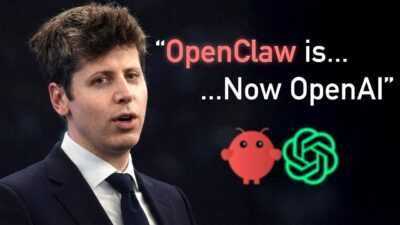
OpenAI just hired the creator of OpenClaw, one of the fastest-spreading open-source AI agent platforms in the world. At the same time, OpenClaw is rolling out inside browsers through Moonshot AI, getting embedded into Baidu’s search ecosystem with hundreds of millions of users, and expanding across China as a model-agnostic, always-on agent layer.
*https://www.youtube.com/watch?v=ubVLeoglBYE
**
тамкоды
00:00:02 Введение в OpenClaw
- OpenAI наняла создателя OpenClaw Питера Стейнбергера.
- OpenClaw внедряется в браузеры с помощью Moonshot AI и масштабируется с помощью Baidu.
- OpenClaw — агент с открытым исходным кодом, который может автоматизировать задачи и работать в фоновом режиме.
00:01:01 Особенности OpenClaw
- OpenClaw действует самостоятельно, без необходимости постоянного управления.
- За несколько недель набрал более 100 000 звёзд на GitHub и привлек около 2 миллионов посетителей.
- Возникли проблемы с безопасностью и вредоносные навыки.
00:02:00 Переход к OpenAI
- OpenAI не купила OpenClaw, а наняла Стейнбергера для работы над следующим поколением персональных агентов.
- OpenClaw продолжит существовать как проект с открытым исходным кодом.
- Стейнбергер объяснил, что OpenAI предлагает доступ к мощным вычислительным ресурсам и возможность донести идеи об агентах до миллиардов пользователей.
00:03:00 Интеграция с Baidu
- Baidu интегрировала OpenClaw в своё поисковое приложение с 700 миллионами пользователей в месяц.
- Пользователи могут использовать OpenClaw для написания кода, организации файлов, управления электронной почтой и других задач.
- Планируется интеграция с электронной коммерцией и другими сервисами.
00:03:58 Стратегии китайских компаний
- Alibaba и Tencent внедряют ИИ в коммерческие приложения, например, в Taobao.
- OpenClaw привлекает гибкость и возможность работы с разными моделями ИИ.
- Возникают вопросы безопасности и геополитики при использовании автономных агентов в крупных платформах.
00:04:56 Kimmy Claw от Moonshot AI
- Moonshot AI запустила Kimmy Claw, который работает в браузере и предоставляет 40 ГБ облачного хранилища.
- Kimmy Claw подключается к ClawHub с более чем 5000 навыками и имеет оперативный доступ к данным через prograde search.
- Разработчики могут подключать свои автономные настройки OpenClaw к облачному интерфейсу.
00:06:47 Реакция сообщества
- Сообщество разработчиков разделилось: одни видят выигрыш в масштабируемости и стабильности, другие беспокоятся о сути проекта.
- Стейнбергер подчеркнул, что OpenClaw остаётся открытым проектом.
- OpenAI наняла специалиста, глубоко разбирающегося в агентах, что является стратегической победой.
00:07:38 Будущее ИИ
- Борьба переместилась на уровень распространения и экосистем.
- OpenAI делает ставку на талантливых сотрудников и глубокую интеграцию продуктов.
- Moonshot фокусируется на экономичных облачных агентах.
- Baidu играет на масштабе, охватывая огромное количество потребителей.
- Alibaba и Tencent внедряют ИИ в коммерческую деятельность.
- OpenClaw остаётся гибким и может вписаться в любую из этих стратегий.
In this video
Chapters
Transcript
Search transcript
Chapter 1: Intro
0:02
2 seconds
Open AAI just hired the creator of OpenClaw. At the same time, OpenClaw is rolling out inside browsers through
0:09
9 seconds
Moonshot AI, getting deployed at scale through bu and spreading faster than ever as an open-source agent platform.
0:16
16 seconds
OpenAI didn’t buy OpenClaw. It didn’t take [music] the project, but it did absorb the brain behind it. And that single move set off a chain reaction
0:25
25 seconds
across the AI world. So, let’s talk about it. All right, let’s rewind a bit.
Chapter 2: How OpenClaw evolved from a scrappy open-source project into a self-directed AI agent with real autonomy
0:29
29 seconds
Open Claw came out of nowhere late last year. Built by Peter Steinberger, an Austrian developer who’s been around long enough to know what he wants and
0:37
37 seconds
what he [music] doesn’t. It started as a scrappy open-source agent that could actually do things. Not chat, not answer
0:44
44 seconds
trivia. Do things. It could sit on your machine, watch your inbox, deal with insurers, check you into flights, automate browser tasks, run commands,
0:53
53 seconds
and keep working [music] in the background without someone holding its hand every 5 seconds. That alone already put it in a different category. Most AI
1:02
1 minute, 2 seconds
tools still wait for you to ask. Open Claw wakes itself up. It has a heartbeat system. [music] It checks what’s going on, decides something needs to be done,
1:11
1 minute, 11 seconds
and takes action for a mainstream audience. That’s the key difference.
1:16
1 minute, 16 seconds
This feels less like a chatbot and more like software that acts on your behalf.
1:20
1 minute, 20 seconds
And people noticed fast. Within weeks, OpenClaw blew past 100,000 stars on GitHub. At one point, it pulled in
1:28
1 minute, 28 seconds
around two million visitors in a single week. Developers loved it, power users loved it, and social media absolutely ran with it. Suddenly, everyone was
1:36
1 minute, 36 seconds
talking about AI agents instead of prompts. But with speed comes chaos.
1:41
1 minute, 41 seconds
Open Claw had rebrands, trademark headaches, security scares, and at one point, researchers found hundreds of malicious skills uploaded by bad actors.
1:50
1 minute, 50 seconds
There were real concerns around people misconfiguring agents and exposing themselves to data leaks or cyber attacks. China’s industry ministry even
1:58
1 minute, 58 seconds
issued warnings about the risks. At the same time, Steinberger was reportedly burning between 10 and $20,000 a month
2:06
2 minutes, 6 seconds
just to keep things running. And that context is important. Now, enter [music] open AI. Sam Alman comes out on X and
Chapter 3: Why OpenAI hired Peter Steinberger without acquiring OpenClaw — and what that signals for agent strategy
2:14
2 minutes, 14 seconds
drops the announcement. Peter Steinberger is joining OpenAI to work on the next generation of personal agents.
2:20
2 minutes, 20 seconds
OpenClaw will live on as an open- source project inside a foundation with OpenAI continuing to support it. There was no
2:27
2 minutes, 27 seconds
acquisition announcement and [music] no price attached to it. So technically, OpenAI wasn’t buying Open Claw. This was OpenAI hiring the mind behind it and letting the project stay open.
2:38
2 minutes, 38 seconds
Steinberger himself made it clear why.
2:40
2 minutes, 40 seconds
He’s a builder. He already spent more than a decade building a company in the past. Running another one wasn’t the goal. Changing how software works was.
2:49
2 minutes, 49 seconds
And open AI offered something others couldn’t match. Massive compute access.
2:54
2 minutes, 54 seconds
Long-term alignment. A place where agent ideas could [music] actually reach billions of users instead of staying stuck in GitHub threads. Altman didn’t
3:03
3 minutes, 3 seconds
hide the strategy either. He talked openly about multi-agent futures,
3:06
3 minutes, 6 seconds
3:07
3 minutes, 7 seconds
about agents talking to each other, coordinating, and becoming core to OpenAI’s product lineup. In other words, this was about turning agents into a
3:15
3 minutes, 15 seconds
platform layer. And this move came at a very interesting moment. Because while OpenAI was locking in talent, China was
Chapter 4: How Baidu embedded OpenClaw into a 700-million-user app just days before Lunar New Year
3:23
3 minutes, 23 seconds
locking in distribution. Just days before Lunar New Year, BYU announced it was embedding OpenClaw directly into its
3:30
3 minutes, 30 seconds
flagship search app. That app has around 700 million monthly users. Let that number sit for a second. This instantly
3:37
3 minutes, 37 seconds
takes OpenClaw from something you run through Telegram or WhatsApp into something living inside one of the biggest consumer apps on the planet.
3:45
3 minutes, 45 seconds
Users can message it directly. They can use it for coding, organizing files, managing email, planning schedules, and
3:53
3 minutes, 53 seconds
doing everyday digital work without jumping between apps. And BYU isn’t stopping there. The plan includes e-commerce integrations and expansion
4:01
4 minutes, 1 second
across other services. This lines up with what Alibaba and Tencent are already doing. Alibaba pushed its Quen chatbot deep into shopping apps like
4:09
4 minutes, 9 seconds
Taoba [music] where it helped process over a 100 million orders in under a week. Tencent is moving in a similar direction. Everyone wants AI inside the
4:19
4 minutes, 19 seconds
flow of daily life, not sitting on a separate website. And here’s the thing, Open Claw fits that strategy perfectly.
4:26
4 minutes, 26 seconds
It’s model agnostic. It can run on open AI models, Anthropics, Claude, Deepseek, and others. That flexibility makes it
4:34
4 minutes, 34 seconds
incredibly attractive in China, where companies want control over infrastructure and model choice. But it also opens up a whole other
4:41
4 minutes, 41 seconds
conversation, data, security, and geopolitics. Cyber security firms like CrowdStrike have already raised red
4:48
4 minutes, 48 seconds
flags about giving autonomous agents deep access to business systems. When an AI can act, mistakes scale fast. And
4:56
4 minutes, 56 seconds
when those agents live inside massive platforms tied to national tech ecosystems, people start asking harder questions. And right in the middle of all this, Moonshot AI made its move.
Chapter 5: How Moonshot AI launched Kimi Claw as a browser-native, always-on cloud agent with persistent memory
5:07
5 minutes, 7 seconds
They launched Kimmy Claw, which is essentially OpenClaw running natively in the browser on kimmy.com. You don’t have to mess with local setups or wrestle
5:15
5 minutes, 15 seconds
with Docker configs anymore. You open a browser tab and the agent is already there, persistent, [music] always on, and running 24/7. This is a big shift.
5:24
5 minutes, 24 seconds
Kimmy Claw comes with 40 GB of cloud storage tied directly to the agent. That means it can hold large data sets, documentation, code bases, and use them
5:33
5 minutes, 33 seconds
across sessions. For anyone familiar with AI limits, this matters. Context usually disappears. Here, it sticks around. It also plugs into Claw Hub, a
5:42
5 minutes, 42 seconds
library with over 5,000 [music] community-built skills. These skills act like modular abilities. The agent can chain them together, call external
5:50
5 minutes, 50 seconds
tools, automate workflows, and interact with thirdparty services without someone writing custom integrations from scratch. Moonshot also added live data
5:59
5 minutes, 59 seconds
access through what they call prograde search. The agent can pull realtime information like financial data instead of guessing based on old training. That
6:08
6 minutes, 8 seconds
reduces hallucinations and makes it usable for time-sensitive work. And then there’s yo, bring your own claw.
6:15
6 minutes, 15 seconds
Developers can connect their own self-hosted OpenClaw setups to the cloud interface or bridge them into apps like Telegram. That hybrid approach keeps flexibility while offering convenience.
6:26
6 minutes, 26 seconds
From a product perspective, this is Moonshot betting on frictionless hosting. From a strategic perspective, it’s China offering a polished managed
6:34
6 minutes, 34 seconds
agent layer that competes directly with whatever OpenAI plans to roll into chat GPT. And interestingly enough, Kimmy Claw launched the same day Steinberger’s move to OpenAI became public.
6:45
6 minutes, 45 seconds
Coincidence? Maybe. Strategic? Almost certainly. Now, reactions across the developer community are split. Some see
Chapter 6: Why OpenClaw’s model-agnostic design makes it uniquely powerful across Western and Chinese ecosystems
6:52
6 minutes, 52 seconds
this as open claw winning, validation, scale, stability, a path into mainstream products used by hundreds of millions of
6:59
6 minutes, 59 seconds
people. Others worry about the soul of the project. They joke about closed claw. They worry corporate gravity will slowly reshape something that thrived on
7:06
7 minutes, 6 seconds
openness and chaos. Steinberger seems aware of that tension. He’s been clear that openclaw stays open, MIT licensed
7:14
7 minutes, 14 seconds
and foundationbacked. Open AAI supports it but doesn’t own it, at least on paper. And for OpenAI, this hire sends a signal. After losing high-profile talent
7:22
7 minutes, 22 seconds
to Meta and seeing rivals gain ground, locking in someone who understands agents deeply is a strategic win, especially when Anthropic is pushing
7:30
7 minutes, 30 seconds
Claude deeper into enterprise workflows with tools like Claude code and longer running task execution. This race is shifting. Benchmarks still matter, of
7:38
7 minutes, 38 seconds
course, and people will keep arguing about model size, reasoning, and coding skills, but the real fight has shifted higher up the stack toward distribution,
7:46
7 minutes, 46 seconds
ecosystems, and who actually controls the layer where real work gets done.
7:50
7 minutes, 50 seconds
Open AAI is clearly leaning into talent and deep product integration, while Moonshot is pushing hard on costefficient cloudnative agents. And
7:59
7 minutes, 59 seconds
BYU is playing the scale game with [music] massive consumer reach. Alibaba and Tencent are pulling AI straight into commerce. And right in the middle of all
8:07
8 minutes, 7 seconds
that sits OpenClaw, flexible enough to plug into every one of those strategies.
8:11
8 minutes, 11 seconds
So here’s the real question. Was this a move to support open-source agents or a move to make sure the most important decisions happen inside OpenAI? Let me
8:19
8 minutes, 19 seconds
know in the comments. Hit subscribe, drop a like. Thanks for watching and I’ll catch you in the next one.
Sync to video time