
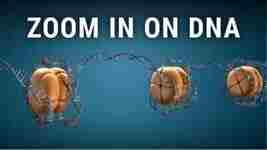
This animation starts with a whole human and zooms in through the organs and tissues to the cells and finally the DNA. You can see how all these different levels of organisation fit together, and the relative scale of each level.
*https://www.youtube.com/watch?v=wZozOrFluiw
**https://300.ya.ru/summary
таймкорды
00:00:02 Системы органов
- Крупные организмы, такие как человек, состоят из систем органов, например, кровеносной и пищеварительной.
- Эти системы включают множество органов, включая печень.
00:00:24 Структура органов
- Органы состоят из тканей, а ткани — из клеток.
- Каждая клетка выполняет определённую функцию.
00:00:45 Органеллы клетки
- Внутри клетки есть органеллы: клеточная мембрана, митохондрии и ядро.
00:01:07 Ядро и хромосомы
- Ядро содержит 23 пары хромосом, включая пару, определяющую биологический пол.
- Каждая хромосома представляет собой длинную спираль ДНК.
00:01:29 Структура ДНК
- ДНК обернута вокруг белков гистонов и имеет двойную спираль.
- Она состоит из четырёх нуклеотидов: аденина, цитозина, гуанина и тимина.
- Порядок оснований в генах содержит инструкции для структуры и функционирования клетки.
00:02:16 Геном
- Одна копия всей ДНК-инструкции для организма называется геномом.
00:02:26 Роль генома
- Геном, организованный в хромосомах, сообщает каждой специализированной клетке, как взаимодействовать с соседними клетками.
- Из них состоят ткани, которые вместе образуют органы, работающие в системах органов и позволяющие организму расти и жить.
Transcript
0:03
Large organisms like humans are made up
0:06
of organ systems
0:08
such as the circulatory system
0:11
and digestive system. These systems
0:14
include a number of organs.
0:18
One of them is the liver.
0:24
Look closer. And these organs are made
0:26
up of tissues.
0:32
And these tissues are built of cells,
0:35
each specialized to perform a particular
0:37
function.
0:45
Within each cell are structures and
0:48
compartments called organels.
0:51
These include the cell membrane,
0:55
mitochondria,
0:58
and nucleus.
1:07
The nucleus contains 23 pairs of
1:10
chromosomes,
1:12
including a pair that determine your
1:14
biological sex.
1:20
Each chromosome is one long length of
1:22
tightly coiled DNA.
1:30
Unwind it and we see the DNA is wrapped
1:32
around proteins called histones.
1:37
The DNA is a double helix like a twisted
1:40
ladder.
1:42
It is made up of four nucleotides which
1:45
contain different bases.
1:47
adinine, cytosine, guanine and thymine.
1:52
A, C, G, and T.
1:57
A always pairs with T and C always pairs
2:01
with G. The order or sequence of these
2:05
bases in specific sections of the DNA
2:08
called genes carries the instructions
2:11
for a cell’s structure and function.
2:16
One copy of the entire DNA instructions
2:18
for an organism is known as the genome.
2:26
The genome, organized in chromosomes
2:28
within the nucleus, tells each
2:31
specialized cell how to function with
2:33
its neighbors. These make the tissues
2:35
that together build organs, which work
2:38
in organ systems and collectively enable
2:40
an organism to grow and live.