
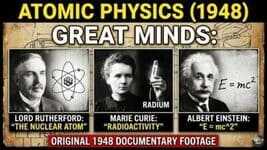
Produced by United World Films for the J. Arthur Rank Organization, Ltd., this film discusses the history and development of atomic energy, stressing nuclear physics. Michael Faraday’s early experiments in electrolysis, Dmitri Mendeleev’s periodic table, and early concepts regarding atoms and molecules are also discussed. The film presents research tools of nuclear physics, explains the work of Frédéric Joliot-Curie and James Chadwick in the discovery of the neutron and the splitting of the lithium atom by John Cockcroft and Ernest Walton. Albert Einstein is shown as he told how their work illustrated his theory of equivalence of mass and energy. Featured scientests include J. J. Thomson, Ernest Rutherford, J. D. Cockcroft, and O. R. Frisch.
*Atomic Physics (1948)
**https://www.youtube.com/watch?v=NpoqaMmlQ_I
***https://300.ya.ru/summary
таймкоды
00:01:21 Атомная теория Джона Дальтона
- В 1826 году сэр Хамфри Дэви вручил Джону Дальтону королевскую медаль за разработку теории определённых пропорций.
- Дальтон официально закрепил идею о материи как научной теории, ранее существовавшей как вера без доказательств.
- Благодаря точным методам взвешивания и анализа Дальтон смог точно рассчитать относительный суммарный вес многих веществ.
00:02:49 Основные идеи атомной теории
- Согласно Дальтону, материя состоит из мелких частиц, которые невозможно разделить на более мелкие.
- Эти частицы он назвал атомами.
- Все атомы одного элемента абсолютно одинаковы и имеют характерный относительный вес.
- Атомы неразрушимы и не могут быть созданы.
- Химическое соединение происходит между целым небольшим числом атомов, образуя молекулы.
00:03:57 Система символов Дальтона
- Дальтон изобрёл систему символов для обозначения атомов различных элементов.
- Он использовал эти символы, чтобы показать, как атомы соединяются для образования молекул.
00:04:51 Периодическая таблица Менделеева
- В 1869 году Дмитрий Менделеев представил периодическую таблицу, в которой элементы были сгруппированы в соответствии с их атомными массами и свойствами.
- Элементы расположены слева направо в порядке возрастания атомной массы.
- Свойства и место в таблице неизвестных элементов были предсказаны, и последующие открытия подтвердили точность этих прогнозов.
00:05:53 Электричество и атомы
- Майкл Фарадей доказал, что определённое количество электричества связано с определённым количеством элементов, образующихся на электродах.
- Было установлено, что существует два вида электричества: положительный и отрицательный.
- В растворе, например в водном растворе хлорида натрия, хлорид натрия существует в виде ионов, или заряженных атомов натрия и хлора.
00:07:14 Броуновское движение
- Ботаник Роберт Браун первым увидел броуновское движение в микроскоп.
- Это сложное движение, которое придаётся мелким частицам, находящимся во взвешенном состоянии в жидкости, при столкновении молекул.
- Каждая молекула настолько мала, что в одном кубическом кубе газа при нулевой температуре по Цельсию и нормальном давлении содержится 27 миллионов миллионов миллионов молекул.
00:11:03 Открытие электронов
- В 1897 году сэр Джозеф Джон Томсон разработал прибор для измерения отношения заряда к массе частиц, которые были названы электронами.
- Он смог приблизительно определить фактическую массу электрона.
- Масса электрона составляет 1/1840 массы атома водорода.
00:13:13 Камера Вильсона
- Профессор Чарльз Вильсон сконструировал камеру, в которой заряженные частицы оставляли за собой след из капелек влаги.
- Камера представляла собой стеклянную колбу, наполненную влажным воздухом, с поршнем, удерживаемым воздухом под ним.
- При открытии клапана воздух под поршнем засасывался в вакуумную камеру, и поршень резко опускался, в результате чего влажный воздух расширялся и образовывалось облако.
00:15:15 Практическое применение электронов
- Электроны используются в радиоклапане, радаре и телевизоре.
- Своей практической полезностью электрон обязан своей малости.
00:16:55 Канальные лучи и ионы
- Исследование канальных лучей, впервые открытых Гольдштейном в 1886 году, доказало, что положительно заряженные частицы остаются позади при излучении отрицательных электронов.
- Сэр Джозеф Джон Томсон сконструировал прибор для измерения массы положительных лучей.
- Каждый отдельный вид положительных лучей состоит из заряженных атомов газа, присутствующего в разряженной трубке.
00:19:07 Открытие рентгеновских лучей
- В 1896 году Ренкен обнаружил, что зелёное свечение при столкновении катодных лучей со стеклом испускает лучи, которые заставляют флуоресцентный экран светиться.
- Эти лучи могут проникать через лёгкие металлы, но не через плотные материалы, например свинец.
- Центральная металлическая пластина из свинца, а внешние — из алюминия. Свинец полностью поглощает лучи, но более лёгкие элементы пропускают их, и на фотопластинке образуется более светлая тень.
00:19:45 Применение рентгеновских лучей
- Рентгеновские лучи получили название рентгеновских.
- Врачи обнаружили, что с помощью рентгеновских снимков можно заглянуть внутрь человеческого тела.
- Стоматологи получили возможность изучать внутреннюю структуру зубов.
- Для поиска скрытых дефектов были разработаны промышленные рентгеновские аппараты.
00:20:29 Открытие радиоактивности
- Французский учёный Беккерель заинтересовался флуоресценцией, которую вызывают рентгеновские лучи в некоторых минералах.
- Он положил металлический медальон на фотопластинку, не экспонированную и всё ещё завернутую в чёрную бумагу, затем насыпал на чёрную бумагу немного флуоресцентной соли урана и положил её поверх медальона.
- Через некоторое время он проявил пластинку и сделал отпечаток. Излучение урана оставило на пластинке изображение медальона.
- Так Беккерель открыл радиоактивность.
00:21:33 Радиоактивность ураноторита
- Радиоактивность ураноторита проявилась в его воздействии на фотопластинку.
- Мария Кюри и её муж Пьер выделили из ураноторита долю грамма чрезвычайно радиоактивного вещества.
- Кюри назвали этот элемент радием и посвятили остаток жизни изучению радиоактивности.
00:22:56 Природа радиоактивного излучения
- Сложную природу излучения радиоактивных веществ удалось выявить, зафиксировав его поведение в магнитном поле.
- В слабом магнитном поле происходит отклонение лёгких заряженных частиц, называемых бета-лучами.
- В очень сильном поле бета-лучи отклоняются ещё сильнее, а более тяжёлые заряженные частицы отклоняются в противоположную сторону.
- Это так называемые альфа-лучи.
- Гамма-лучи представляют собой электромагнитное излучение, на которое не действует магнитное поле.
00:23:49 Эксперименты с радием
- Кюри и Лабор обнаружили, что лучи радия могут преобразовывать свою энергию в тепло.
- Эксперимент с двойными колбами показал, что соль радия нагревает соль бария.
- Количество тепла, выделяемого радием, рассчитывается исходя из количества электричества, затраченного на нагрев бария до той же температуры.
00:24:25 Превращение атомов
- Резерфорд поместил радиоактивный газ радон в тонкостенный стеклянный куб, окружённый альфа-частицами.
- Альфа-частицы, испускаемые газом, проникали через тонкое стекло и попадали во внешнюю трубку, из которой был откачан воздух.
- Через несколько часов во внешней трубке был обнаружен гелий.
- Это стало первым прямым доказательством того, что один вид атомов может превращаться в другой.
00:28:07 Теория строения атома
- Резерфорд выдвинул теорию о строении атома: в центре атома находится маленькое положительно заряженное ядро, вокруг которого вращаются электроны.
- Заряд ядра в точности компенсирует заряд электронов.
- Нильс Бор развил теорию Резерфорда, разработав модели сложных орбит электронов.
00:30:02 Экспериментальное подтверждение теории
- Вильсоновская камера Вильсона предоставила экспериментальное подтверждение теории строения атома.
- На фотографиях видны треки альфа-частиц в момент образования.
- Треки прямые и чётко очерченные из-за скорости и относительно большой массы этих частиц.
- Некоторые треки имеют резкие изгибы, вызванные действием силы, способной отклонить тяжёлую альфа-частицу.
00:32:03 Рентгеновские спектры и атомный номер
- Г. Мозли использовал дифракцию рентгеновских лучей на кристалле для получения рентгеновских спектров различных элементов.
- Рентгеновские спектры показали, что характерная длина волны плавно увеличивается по мере продвижения по периодической таблице.
- Мозли соотнёс свои числа Q с атомными номерами, придя к выводу, что заряд положительного ядра является фундаментальной величиной в атоме.
00:34:26 Трансмутация атомов
- Резерфорд изучал возможность реального преобразования атомов.
- В 1919 году он обнаружил, что ядра азота можно преобразовать, бомбардируя их быстрыми альфа-частицами.
- Из ядер азота с высокой скоростью выбрасываются протоны.
- Это была трансмутация — мечта алхимиков, которой ядерная теория наконец-то придала материальную форму.
00:35:59 Атомные номера и массы
- Атомные номера показывают заряд ядра и определяют порядок элементов по возрастанию атомной массы.
- Атомная масса большинства элементов минимум в два раза больше атомного номера.
- Пример с литием: вокруг ядра вращаются три электрона, но для баланса заряда нужно добавить четыре электрона.
00:37:50 Теория Резерфорда
- Резерфорд предположил существование нейтральной частицы с массой протона для объяснения дополнительной массы без изменения заряда.
00:38:32 Исследования Резерфорда и развитие оборудования
- Учёные продолжили исследования Резерфорда, используя флуоресцентные экраны и электрические методы для автоматического подсчёта частиц.
- Разработка радиоклапанов позволила усиливать ток от каждой альфа-частицы.
00:40:27 Ионизационные камеры и счётчики Гейгера
- Гейгер и Миллер разработали ионизационную камеру, которая многократно усиливает первоначальный эффект.
- Современные счётчики Гейгера способны регистрировать гамма-излучение со скоростью тысяч в минуту.
00:41:56 Масс-спектрограф Эстона
- Эстон сконструировал масс-спектрограф, который позволил точно определить массу атомных ядер.
- Масс-спектрограф показал, что большинство элементов представляют собой смесь двух или более веществ с разной атомной массой.
00:43:10 Изотопы и нейтроны
- Эстон обнаружил, что хлор с атомной массой 35,5 представляет собой смесь двух форм с массами 35 и 37.
- Нейтроны объяснили существование изотопов, так как их масса равна массе протона, но они не имеют заряда.
00:44:08 Открытие нейтронов
- Бота и Беккер зафиксировали необычное гамма-излучение при бомбардировке бериллия альфа-частицами полония.
- Фредерик и мадам Кюри измерили проникающую способность излучения, используя экраны из различных материалов.
- Сэр Джеймс Чедвик предположил, что протоны выбрасываются из парафина незаряженной частицей, которая была названа нейтроном.
00:49:04 Бомбардировка атомов
- В Кавендишской лаборатории специалисты используют электрические машины для разгона пучков заряженных частиц до высоких энергий.
- Кокрофт и Уолтон в 1932 году получили важные результаты, бомбардируя литий протонами.
00:52:06 Теория относительности Эйнштейна
- Специальная теория относительности Эйнштейна показывает, что масса и энергия эквивалентны.
- Уравнение E = mc² демонстрирует, что очень малая масса может быть преобразована в очень большое количество энергии.
- Это было продемонстрировано Кокрофтом и Уолтоном в 1932 году.
00:53:06 Экспериментальное исследование распада лития
- Учёные обнаружили, что изотоп лития с массой 7 иногда захватывает протон.
- Ядро лития с массой 8 распадается на два ядра гелия с массой 4 и энергией около 8 миллионов электронвольт каждое.
00:53:37 Запись реакции распада
- Реакция записывается с использованием символов лития и водорода.
- В результате реакции получаются две альфа-частицы гелия.
00:54:41 Расчёт энергии реакции
- Разница масс до и после реакции составляет 0,056 единиц массы.
- Эта масса преобразуется в энергию согласно уравнению Эйнштейна E = mc².
- Вычисленная энергия составляет 27,5 эрг.
00:56:09 Энергия альфа-частиц
- Энергия каждой альфа-частицы составляет 8,5 миллионов электронвольт.
- Общая энергия реакции равна сумме энергий альфа-частиц — 17 миллионов электронвольт.
00:57:04 Развитие ускорителей
- Физики-ядерщики создают машины с более высоким напряжением для исследований.
- Синхротроны разгоняют электроны до фантастических скоростей.
- Линейные ускорители электронов и электростатические генераторы используются для ускорения частиц.
00:59:24 Принцип работы циклотрона
- Циклотрон изобретен профессором Лоуренсом.
- Ионы образуются в центре бака под действием электронов и ускоряются переменным напряжением.
01:02:22 Эксперимент с нейтронами
- Нейтроны могут захватываться ядрами, делая их нестабильными.
- Захват нейтрона может привести к выбросу частиц из ядра и его распаду.
01:03:38 Открытие деления урана
- Ган и Штрассман обнаружили, что при бомбардировке урана нейтронами образуется изотоп бария.
- Профессор Фриш подтвердил деление урана экспериментально.
01:06:10 Цепная реакция деления
- При каждом акте деления высвобождается несколько нейтронов.
- Существует возможность самоподдерживающейся цепной реакции.
01:07:42 Создание атомной бомбы
- Возможность быстрой цепной реакции натолкнула на мысль о создании атомной бомбы.
- Уран-235 делится под воздействием медленных нейтронов.
- 2 декабря 1942 года была достигнута управляемая цепная реакция с использованием замедлителя.
01:09:17 Создание атомной бомбы
- Замена природного урана и замедлителя небольшим количеством чистого U235 приводит к реакции на быстрых нейтронах.
- При превышении критического размера U235 начинается быстрая цепная реакция, приводящая к взрыву.
- Для создания бомбы нужно соединить два куска U235, каждый из которых меньше критического размера, но при соединении превысит его.
01:10:15 Роль U-238 и образование плутония
- Медленные нейтроны захватываются U-238, превращая его в U-239, который нестабилен и испускает бета-частицу, образуя нептуний-239.
- Нептуний-239 также нестабилен и испускает ещё одну бета-частицу, образуя плутоний-239.
- Плутоний-239 обладает свойствами, аналогичными U-235, и его можно отделить от урана химическим путём.
01:10:55 Производство урана и плутония
- В США были построены заводы по производству чистого урана-235 и плутония.
- Британские физики-ядерщики продолжили работу в США и Канаде.
- Работники реакторов и химических лабораторий соблюдали меры предосторожности из-за опасности гамма- и нейтронного излучения.
01:12:32 Первая атомная бомба
- Первая атомная бомба была взорвана в пустыне Нью-Мексико в условиях строжайшей секретности.
- Через несколько недель бомба упала на Японию, вызвав шок и осознание безотлагательности ситуации.
- Хиросима была разрушена, погибло 60 000 человек.
01:13:26 Атомная энергия и её будущее
- Профессор Эйнштейн считал, что использование атомной энергии в конструктивных целях пока невозможно.
- Для использования атомной энергии в малых количествах требуются редкие и нестабильные элементы.
01:14:39 Атомные реакторы как источники энергии
- Атомный реактор можно превратить в тепловой двигатель, используя систему охлаждения и стержни из кадмия для контроля реакции.
- Пар от реактора можно использовать для привода турбогенераторов, вырабатывающих электроэнергию.
- В США и Великобритании разрабатываются способы использования атомного реактора в качестве источника тепловой энергии.
01:16:12 Радиоактивные индикаторы в медицине
- Радиоактивные индикаторы используются в медицинских исследованиях, например, для определения времени циркуляции крови.
- Эксперименты с радиоактивным натрием помогают предотвратить осложнения после родов.
01:16:47 Ядерные реакции в природе
- В условиях высокой температуры и давления происходят сложные ядерные реакции, в результате которых из водорода образуются ядра гелия.
- Возможно, в будущем человек научится получать энергию, синтезируя более тяжёлые атомы из более лёгких.
01:17:23 Мирные цели атомной энергетики
- ООН пытается найти формулу для отказа от атомной бомбы и использования атомной энергетики в мирных целях.
- Исследовательский центр в Хауэле под руководством доктора Кокрофта изучает возможности мирного использования ядерной энергии.
01:19:14 История атомной науки
- В XIX веке на основе атомной теории Дальтона было составлено полное представление об элементах материального мира.
- Открытие электронов и изучение радиоактивности позволили Резерфорду представить атом в виде ядра, окружённого электронами.
- В 1932 году учёные подтвердили состав атома: электроны, протоны и нейтроны.
01:21:04 Деление ядра урана
- В 1939 году было впервые зафиксировано деление ядра урана.
- Управляемые цепные реакции были осуществлены в ядерных реакторах.
- Перспектива использования реакторов в качестве источников тепловой энергии и радиоактивных материалов для медицинских целей поразила мир.
Расшифровка видео
1:22
In the year 1826. Sir Humphrey Davy, as president of the Royal Society,
1:27
presented Mr. John Dalton with a royal medal for his development of the theory of definite proportions, usually called the Atomic Theory of Chemistry.
1:46
This presentation set an official seal upon the emergence as a scientific theory of an idea
1:52
of matter, which had existed for over two thousand years as a belief, unsupported by experimental proof.
2:08
In Dalton’s time, chemistry was becoming an exact science. Thanks to accurate methods of weighing and analysis introduced in the 18th century.
2:17
Dalton was able to work out, fairly accurately, the relative combining weights of many elements.
2:24
In his new system of chemical philosophy, published in 1808,
2:32
Dalton pointed out that these combining weights, which are constant for each particular compound, must be related to the
2:40
weights of the ultimate particles or atoms of the combining elements.
2:49
Thus, the atomic theory was reborn. According to
2:55
Dalton, matter is composed of small particles, which cannot be split up any smaller.
3:01
These particles he called atoms. Our diagrams illustrate his ideas, but
3:09
not, of course, the real shapes of atoms. He believed secondly, that all atoms of one element
3:18
are exactly alike, and differ from the atoms of other elements, and have a characteristic relative weight.
3:24
Thirdly, he believed that atoms are indestructible, and cannot be created.
3:30
Fourthly, the
3:35
chemical combination occurs between small, whole numbers of atoms.
3:45
Such combinations of atoms are now called molecules, in any given compound, all molecules are alike.
3:57
Dalton invented a system of symbols to represent the atoms of the different elements.
4:09
He used these to show how the atoms combined to form molecules.
4:21
Though some of his conclusions proved wrong, atomic theory was the foundation upon which the chemistry of the 19th century was built.
4:29
The painstaking
4:34
chemical analysis, based on Dalton’s theory, and research arising out of Evigardro’s hypothesis concerning molecules and gases,
4:42
enabled accurate atomic weights to be assigned to the elements. A connection
4:52
was sought between atomic weights and chemical properties. And in 1869, this was supplied
4:58
by Mendelepp’s periodic table, which arranged all the elements then known in families, according to their atomic weights and properties.
5:08
Thus, the
5:14
column headed by carbon contains a group of elements, with mostly similar properties. The next column contains another group of similar elements, and so on.
5:23
Now, from left to right, the elements are arranged in a sending order of atomic weight.
5:30
The whole table fits together like a puzzle.
5:35
The properties and place in the table of unknown elements were predicted. And the discoveries of
5:42
later years proved the accuracy of these forecasts.
5:54
The decomposition of solutions by an electric current was used as a means of chemical analysis in the early 19th century.
6:01
By careful measurement, Michael Faraday was able to show that in such cases, a definite
6:08
quantity of electricity was associated with definite amounts of the elements produced at the electrodes, that is, with definite numbers of atoms.
6:22
Hence, he suspected that electricity itself might be atomic by nature.
6:27
It was established that there were two kinds of electricity, unlike charges attracted each other.
6:37
Like charges repelled each other. By convention,
6:42
these two kinds of electric charge became known as positive and negative.
6:53
In a solution, like common salt in water, the sodium chloride exists as irons or charged atoms of sodium and chlorine.
7:02
When the solution is electrolyzed, the positive sodium ions travel towards the cathode and the negative chlorine ions to the anode.
7:14
The work of many scientists on liquids and gases led to the theory that in all matter, molecules are in a state of perpetual motion.
7:22
The botanist, Robert Brown, was the first to see, in his microscope, what is now called Brownian motion.
7:30
This is the intricate motion imparted to fine particles in suspension in a liquid by the impact of molecules.
7:38
One can imagine that tiny particles being pushed about by these ceaselessly active molecules.
7:47
Each molecule is so small that 27 million million million are contained in one c.c. of gas at
7:54
not degrees centigrade and normal pressure.
8:03
The thinnest soap bubble that can be made by ordinary means is about 100,000th of a centimetre thick.
8:11
In this space about one thousand molecules could lie side by side. Each of these molecules would
8:19
be three or four times the size of a small atom. This much was known at the close of the nineteenth century,
8:26
which Lord Rutherford sums up in these words.
8:33
At the close of the nineteenth century, the labors of the chemist had resolved the matter of our material
8:40
world into 80 or more distinct elements, and the atoms of these elements appear to be permanent
8:47
and indestructible by the forces then at our command.
9:05
The physicists of the 19th century were not less active than the chemists. Faraday investigated the conduction of electricity by liquids.
9:13
Later scientists investigated the passage of electric currents through gases at low pressures, with this kind of apparatus.
9:21
Air is
9:27
pumped from the tube until a luminous discharge passes from cathode to anode.
9:33
As evacuation proceeds, brilliant rays are seen streaming from the cathode.
9:38
The rays become invisible as pressure is reduced, but they still cause a faint green glow on the walls of the tube.
9:45
This bell shaped vessel shows the behavior of the cathode rays more clearly.
9:52
At first, the current passes from the cathode to the edge of a fluorescent screen beneath it.
9:57
Next, the glow of the cathode rays is clearly seen around the cathode itself.
10:04
As the pressure continues to fall, the rays will disappear, but their
10:11
presence is revealed by a powerful green glow where they strike the fluorescent screen. These cathode
10:20
rays can be made to cast a shadow of an object in their path. This proves that they travel in straight lines from the cathode.
10:26
The rays are capable of transmitting energy.
10:32
The little veins in this tube are turned by energy supplied from the motion of the tiny particles rushing up from the glowing cathode beneath.
10:41
It can be proved that the rays are negatively charged.
10:48
A wire connected to a plate on which the rays fall will discharge a positively charged electroscope.
11:03
In 1897, Sir J.J. Thompson divides an apparatus to measure the ratio of
11:08
charge to mass of these particles, which had been named electrons. He was able to make an estimate of the actual mass of the electron.
11:17
In this apparatus, a luminous spot showed where the electron beam from the cathode fell
11:23
on a fluorescent coating on the end of the tube. This beam
11:29
could be deflected in one direction by an electrostatic field between charged plates.
11:38
And in the other direction, biomagnetic field. These fields could be adjusted to balance each
11:44
other, and from their strength, the velocity of the particles could be calculated. Then, from the
11:52
strength of the magnetic field alone and the deflection caused by it, the ratio of charge to mass could be found.
11:58
From experiments such as these, the mass of the electron has been estimated at one 1840th of the mass of the hydrogen atom.
12:08
Sir J.J. Thompson’s own description of this tiny object had been preserved for us. Could anything at first sightsee more impractical?
12:18
Donner body? which can only exist in vessels, will make
12:25
all but a minute fraction of the air has been extracted, which
12:33
is so small, that its mass is an insignificant fraction of the mass
12:39
of an atom of hydrogen, which itself is so small.
12:47
Got a crowd of these atoms, equal in number to the population of the whole world,
12:55
would be too small to have been detected by any means then known to science.
13:03
Thus the existence of a negatively charged subatomic particle.
13:08
The electron was established beyond all doubt. It was even found possible
13:14
to photograph the track of an election. This was done by an ingenious apparatus
13:19
invented by Professor C.T.R. Wilson.
13:28
During the war, most people saw the vapor trails left by high flying aircraft.
13:38
Wilson, while investigating the ionization of gases by charged particles, built a chamber in which such
13:45
particles could be made to leave a vapor trail. It consisted of a glass
13:51
cup chamber filled with moist air. The bottom of the chamber is really a piston head, supported by the air beneath.
13:58
Connected by a valve to the main apparatus is a large vacuum chamber.
14:06
When the valve is opened, the air beneath the piston is sucked into the vacuum.
14:12
And the piston drops sharply. Creating an expansion of the moist air, so that a cloud is formed.
14:30
Now, a charged particle from a source of radiation, entering the chamber, will ionize the gas along its path.
14:36
Because of the sudden expansion, drops of moisture will condense on
14:43
the charged atoms or irons along the path of the radiation and leave a visible trail.
14:48
This is photographed by a synchronized electric flesh.
15:06
This apparatus, much improved since the original model, has proved invaluable in atomic research.
15:12
Today, the electron is a commonplace.
15:17
Any metal raised to red heat gives off electrons. The stream of electrons from this hot filament can discharge an electroscope.
15:29
This is made use of in the radio valve. Where the electrons from the heart filament can be used
15:36
to send and detect signals, broadcast over long distances.
15:43
On this radar screen, electrons act as the eyes of a ship, as it makes its way down the crowded river to the sea.
15:50
And on the television screen, electrons paint pictures for our amusement.
16:00
The, uh, electron? Oh, it’s practical utility to its smallness.
16:06
It might, the thoroughness, Shakespeare. Say, my use is great because I am so small.
16:14
The discovery of electrons raised big problems.
16:21
Ordinary matter is neutral. For instance, it has no effect on an electroscope.
16:26
Yet the cathode in this discharged tube can give off negative particles much smaller than atoms, which can turn the disk beneath.
16:34
Some sort of electrical equilibrium has been upset by this emission of negative electrons from neutral matter.
16:41
Surely positively charged particles must have been left behind. Investigation of the so called canal
16:48
rays, first discovered by Goldstein in 1886, proved that this conjecture was true.
16:56
If a series of small slits be pierced in the cathode of a gas filled tube, a luminous ray can be seen streaming in the opposite direction to the cathode rays.
17:09
These rays were subsequently found to be positively charged. So J.J.
17:14
Thompson used this discovery to build an apparatus in which the mass of the rays could be measured.
17:19
A fine beam of positive rays was directed onto a photographic plate.
17:33
A magnetic field produced a deflection of the beam horizontally.
17:43
Similarly, an electrostatic field produced a vertical deflection. In both cases, the different velocities of individual particles
17:52
produced a line instead of a spot. If both
17:57
fields were applied simultaneously, the particles fell on the plate in a parabola.
18:09
The position of this parabola, in relation to that of the undeflected spot, was determined solely by the ratio of mass to charge.
18:17
Thompson was able to calculate the mass of these particles. He found that each particular kind of positive ray consisted
18:25
of charged atoms of the gas present in the discharged tube. Under certain conditions, the
18:32
different types of glow due to positive and cathode rays can both be seen. These phenomena could only be explained
18:39
by supposing that the neutral atom contained both positive and negative charges in equilibrium.
18:46
The stream of electrons from the cathode detaches other elections from the atoms of the gas through which they pass.
18:51
These atoms immediately become positively charged, and rush towards the cathode.
18:57
If the cathode is pierced, they emerge as positive rays. The sequence of events resembles electrolysis,
19:04
and these charged atoms of gas are called irons. A guess in which such conditions arise is said to be ionized.
19:13
In 1896, Redken found that the green glow excited by cathode rays striking the glass was itself
19:20
giving off rays, which caused a fluorescent screen to become luminous. The rays could penetrate light metals, but not dense material like lead.
19:29
The centerpiece of metal here is lead, the outer ones are aluminum.
19:36
Lead stops the rays completely, but the lighter elements are penetrated and cast a lighter shadow.
19:45
These powerful rays became known as X rays, and doctors soon found that they could use shadow graphs made with
19:51
X rays to see inside the human body. Dentists were
20:00
able to study the internal structure of teeth.
20:05
And industrial X ray machines such as this one have been developed to search for hidden defects.
20:30
But in 1896, inquiry turned to the fluorescence produced by x rays in certain minerals.
20:36
The French scientist, Becquerel, investigated whether fluorescent substances could, in turn, give off X rays.
20:44
He placed a metal medallion on top of an unexposed photographic plate still wrapped in black paper.
20:50
Next, he shook on to black paper a quantity of a fluorescent salt of uranium, and placed it over the medallion.
21:04
Some time later, he developed the plate and made a print. Radiation from
21:13
the uranium had produced an image of the medallion. Becquerel had discovered radioactivity.
21:23
This radiation was discovered to be a property of any mineral containing uranium.
21:34
Among such minerals are, or tonight, Torbonite,
21:39
and, in particular, pitch blend, which was found to be more active than uranium itself.
21:45
The radioactivity in this pitch blend or has revealed itself by its action on a photographic plate.
21:53
Pioneers in this new field of investigation were Marie Curie and her husband, Pierre.
22:00
By sheer hard labor, she succeeded in isolating, from many tons of pitch blend residue, a fraction
22:08
of a gram of an intensely radioactive substance.
22:14
An exhaustive series of measurements and tests left no doubt that a new element had been discovered, more
22:20
radioactive than any before known. The curies called it radium.
22:28
and devoted the rest of their lives to the study of radioactivity. The power
22:36
of this radiation from radium is easily shown. The scrap
22:42
of radium embedded in this lead capsule ionizes the air to such an extent, the charge on the electroscope leaks away.
22:56
The complex nature of this radiation from radioactive substances was revealed by recording on a photographic plate its behavior in a magnetic field.
23:08
A fairly weak magnetic field produced a deflection of light charged particles called beta rays.
23:15
A very strong field, caused further deflection of the beta rays, and in the opposite direction, a deflection
23:22
of heavier charged particles, the so called alpha rays. There remained a penetrating radiation unaffected by
23:29
the magnetic field, the gamma rays. By 1902, the alpha
23:34
ray was known to be a type positive ray, the beta ray to consist of electrons, and the gamma rays to be
23:41
electromagnetic waves, similar to x rays.
23:49
Cury and Le Borde discovered that the rays from radium can manifest their energy in the form of heat.
23:54
Here are two duar flasks, in which are tubes containing a radium salt on the left, and a barium salt on the right.
24:01
The barium flask also contains a coil of known resistance, which can be used to raise the temperature in the flask.
24:09
Both flasks have thermometers. At the start of the experiment, the left hand thermometer
24:16
shows a higher reading, owing to the heat from the radium. Next, an
24:25
electric current is put through the heating coil. The heat from the radium is calculated from
24:30
the amount of electricity used to raise the barium to the same temperature as the radium.
24:36
Such experiments gave an inkling of the great energy locked in the atom.
24:44
Three years after the discovery of radioactivity by Becquerel, Rutherford enclosed a radioactive gas called radon in
24:51
a thin walled glass tube, which was surrounded by an outer tube, from which all the air had been exhausted.
24:58
The alpha rays coming from the gas, penetrated the thin glass, and collected in the outer tube.
25:05
After a few hours, it was found that the outer tube contained the gas helium. Therefore, the alpha particles were atoms
25:13
of helium, and this was the first direct evidence of one kind of atom actually changing into another.
25:18
A great change in air ideas resulted from the discovery of the
25:25
electron, and of the spontaneous radioactivity, observed in the heavy element, uranium, and thorium.
25:33
Sodhi and I were able to show in 193 that radioactivity was a sign and measure of the instability
25:41
of atoms, and that the atoms of uranium and sorium were undergoing a series of spontaneous transformations.
25:49
Uranium, for instance, during its transformation to lead gives rise
25:56
to a whole new series of unstable elements, which ultimately break down into lead. The rate of change from one element to another
26:04
may vary from a fraction of a second to millions of years. Only a few elements are normally radioactive.
26:11
The majority are completely stable. Now, the
26:20
next problem, whilst you examine, where the means could be found to break up the stable elements by artificial methods.
26:27
Before this could be attempted, with any chance our success, it was necessary to
26:34
have a clearer conception of the structure of atoms. The idea of the nuclear structure
26:41
of atoms, which I suggested in 1911 has proved very usual for this purpose.
26:47
Experimental evidence supported Rutherford’s idea.
26:53
Alpha particles from a radioactive source, if limited by a thin slit, will throw its image sharply on a fluorescent screen.
27:01
A sheet of gold foil, placed in the path of the rays, causes a blurred image of the slit, owing
27:07
to the scattering of alpha particles by the heavy atoms of gold. Geiger and Marsden investigated
27:15
the nature and extent of this scattering. In the apparatus first used, the
27:20
sauce and scattering foil was stationary, inside an evacuated metal box, while the fluorescent screen,
27:27
with a microscope attached, was free to move on a graduated circular platform. Gathering of
27:37
alpha particles continued to be observed as the screen and eyepiece rotated through an increasingly large angle.
27:49
Only a powerful field of force could produce such deflections of heavy charged particles.
27:56
Rutherford visualized a small particle in the center of the atom, carrying a heavy positive charge.
28:02
Since the
28:07
majority of alpha rays passed straight through, he deduced that these positive particles were small and widely separated.
28:15
In 1911, he propounded his theory of the nuclear atom, the
28:21
atom, he said, had a small, positively charged nucleus. Round this, the electrons revolved.
28:29
The charge on the nucleus exactly offset the charges on the elections. The Danish
28:36
physicist, Niels Boer, developed Rutherford’s theory. Here are some models of the elaborate orbits for planetary
28:43
electrons, which Bohr and others worked out by using the quantum theory and certain bold assumptions of their own.
28:59
This is the atom of lithium, one of the lighter elements. And this the simplest atom
29:05
of all, hydrogen, with one electron revolving round a nucleus. They first worked out possible orbits
29:12
for the single electron of the hydrogen atom. They varied from circles to various ellipses.
29:18
The conception became more difficult when it was realized that these elliptical
29:26
orbits themselves rotated, something like this.
29:40
The structure of the atom increases in complexity as we pass from the simple hydrogen atom to helium,
29:47
with its two electrons in the same ring or shell. Lithium, with the
29:53
third electron in an outer shell, beryllium with four electrons, and so on. Wilson’s cloud
30:03
chamber provided experimental proof of the nuclear atom dairy. Here are the tracks of alpha particles at the moment of formation.
30:10
Each of these tracks marks the part of a single alpha particle, a helium atom stripped of its electrons.
30:24
Photographs show that the tracks are straight and heavily defined because of the velocity and relatively large mass of these particles.
30:37
Yet some alpha tracks showed abrupt kinks, caused by some force powerful enough to deflect the heavy alpha particle.
30:46
These kinks show where an atomic nucleus has deflected the alpha particle.
30:53
Other photographs showed tracks ending with little fox. It was realized that these were made by particles after
30:59
direct hits had been scored on atomic nuclei.
31:05
Billiard balls can be used to illustrate a collision between particles of roughly the same mass. The white ball represents an atomic nucleus.
31:12
The black and alpha particle. When the black ball strikes the white, both are deflected and branch off on different tracks.
31:19
This is
31:24
the sort of thing the Cloud Chamber photograph shows. The existence
31:30
of the atomic nucleus having been proved, the next thing was to find out the magnitude of the charge on it.
31:35
See how this was done? We must turn again to x rays. We have already seen how x rays are caused when electrons fall upon any substance.
31:44
X ray tubes were built, with a target on which the electron beam fell.
31:51
Causing X rays to be given off at a convenient angle.
32:03
About 1912, it was found that X rays could be defracted by a crystal, just as light is defracted by a ruled grating.
32:10
H.G. Mosley used this discovery to build an apparatus to obtain x ray spectra of different elements.
32:19
The electron beam was directed downwards from the cathode onto the target carried on the little trolley beneath.
32:26
X rays were given north from the target. A crystal enclosed in a vacuum chamber
32:31
was so arranged that the X rays, passing through a slit, struck the face of the crystal.
32:36
From the crystal face, an X ray spectrum was thrown onto the photographic plate.
32:42
Mostly found that each element used as a target gave off radiation, which included an X ray of a characteristic wavelength.
32:51
The X ray spectra showed that this characteristic wavelength increased smoothly throughout the periodic system, according to a simple law.
32:59
The wave length could be specified by a number, Q, which increased by one, each
33:06
time he passed from one element to the next. The elements had
33:12
already been arranged in a table according to their increasing chemical mass. Moseley related his cue numbers to these atomic numbers.
33:21
He deduced that there was in the atom a fundamental quantity, which increased by regular
33:27
steps from one element to the next, and that this quantity could only be the charge on the positive nucleus.
33:36
Thus, the number of each element in the table, the atomic number, as it is called, acquired a new significance.
33:45
It indicated the positive charge on the nucleus of an atom, equal, though opposite in sign, to
33:51
the number of orbital electrons in the particular atom.
33:58
Of all atoms, hydrogen has the simplest structure, a nucleus and one electron.
34:06
This nucleus, with its single positive charge, was christened by Lord Rutherford, the proton.
34:16
At this time, Rutherford was investigating the possibility of actually transforming Adams.
34:26
It became clear that to affect a veritable transformation of an atom, it was necessary to change the charge
34:33
or mess of a nucleus, or both together. Now, the minute nuclei
34:40
of atoms are held together by powerful forces, and to effect their disintegration, it seemed likely that
34:48
a very concentrated source of energy must be applied to the individual atom.
34:54
The bombardment of the nuclei by the energetic alpha particles from
35:00
radium appeared to be the most promising method for such a purpose. In 1919,
35:08
Rutherford found that nitrogen nuclei could be transformed by bombarding them with swift alpha particles, and that protons
35:16
were ejected at high speed as a result. In effect, he added together helium
35:22
and nitrogen, and changed them into oxygen and hydrogen.
35:28
This was transmutation. The dream of the alchemists, to which the nuclear theory had at last given substance.
35:39
Most significant of all, there could be no doubt that the proton, the hydrogen nucleus, was a fundamental
35:46
particle in all atoms, the positive counterpart of the negative electron.
35:52
How was the atom built up from these atomic bricks?
35:59
Let us go back to our table of the elements. The atomic numbers represent the charge on the nucleus,
36:06
and also number the elements according to their increasing atomic weight. Now consider these atomic weights.
36:13
One for hydrogen, 4 for helium, 7 for lithium, and so on.
36:19
Our figures are approximations to the nearest whole number, but they show that in most cases atomic weights
36:26
are at least twice as great as the atomic number. How could this difference between mass and charge be accounted for?
36:33
Consider the atom of one element, say lithium.
36:42
It has three electrons circling round a nucleus. This nucleus
36:50
we know, must have a positive charge of three. So we put three protons in the nucleus.
36:56
Each has a charge of one and a mass of one. But the atomic weight of lithium is seven approximately.
37:04
So the nucleus must have four more protons added to it to give a mass of seven.
37:16
Now we have upset the balance of the charge. Seven protons, seven positive charges, three
37:23
electrons, three negative charges. There is only one way to correct this. Four electrons must be added.
37:30
Now our charges balanced. The negative charge from the three electrons is balanced
37:37
by the outstanding positive charge of three on the nucleus.
37:50
Such was the theory. But even in 1920, Rutherford suggested that there might be a neutral particle, with the same mass as
37:58
a proton, which could account for the extra mass without affecting the charge. Ultimately, this
38:06
proved to be another instance of his amazing insight. But in the years
38:12
between, the drive to penetrate the secrets of the nucleus continued unabated.
38:32
From 1920 onwards, many other scientists pursued and opened up by Lord Rutherford’s transmutate nitrogen to oxygen.
38:39
Steady accumulation of data went hand in hand with improvement of apparatus. In this little instrument,
38:47
a needle carrying a speck of radium is fixed in front of a fluorescent screen. Through a magnifying lens, the
38:55
screen can be seen to twinkle with tiny points of light. Alpha particles cause these salations as they strike the screen.
39:02
Rutherford’s early experiments were based on the use of such screens to observe and count the scintillations.
39:09
Progress in our knowledge of the mechanism of these transformations became more
39:15
rapid when powerful electric methods were developed, to count automatically, the swift particles were
39:22
ejected during these nuclear explosions. Improved apparatus to videoactive source could be measured.
39:31
Inside the brass case is a single wire which serves as an electrode.
39:37
Suppose that a radioactive source at the bottom of the case is emitting alpha particles.
39:45
This is established between the wire and the outer case, the ionization caused by the alpha particles is collected,
39:52
constituting a current to the central wire. Each alpha particle
39:58
emitted ionizes the gas along its path into positive and negative irons, actually about 100,000 pairs of irons.
40:06
These are pulled apart towards the electrodes in the same way as the irons in a solution being electrolyzed.
40:12
The tiny
40:18
charge collecting on the central wire as a result of continuous alpha particle emission can be measured.
40:23
Development of radio valves enabled the pulse of current from each single alpha
40:31
particle entering the chamber through a micro window to be amplified until it could operate a kind of counter.
40:40
Then Geiger and Miller developed an ionization chamber, which could multiply the original effect by a principle known as gas amplification.
40:47
Here is a modern Geiger counter, capable of counting at the rate of thousands per minute, linked to
40:54
it is an electric counter capable of high speed recording. As the tiny speck of radium fitted to this rod
40:59
is brought near the tube, the dials record the gamma rays from the disintegration of single atomic nuclei.
41:07
These gamma rays are actually penetrating the walls of the tube. But charged particles can be counted by using a suitable type of tube.
41:14
The ionization effect can be amplified and passed through a loud speaker, so that each click represents
41:21
the passage of a single particle, or as in this case, the ionization caused by a single gamma ray.
41:27
The same voltage will operate in a philoscope in which cathode rays trace on a screen the effect of these nuclear explosions.
41:42
Such sensitive apparatus, the comic disintegration and studied and accurate measurements obtained.
41:56
About 1920, Aston, working at the Cavendish laboratory, designed this ingenious instrument, known as the mass spectrograph.
42:09
Positive particles, or irons, produced in the same way as in Professor Thompson’s apparatus, were allowed to pass through
42:15
an electric field, which deflected the particles at varying angles according to their velocity. All particles
42:24
of the same mass could be brought to a common focus on a photographic plate by means of a magnetic field of the right shape and intensity.
42:32
In effect,
42:38
Aston could weigh atomic nuclei very accurately. Work done with this apparatus showed
42:44
that most of the elements accepted as indivisible by the chemist, were actually mixtures of two or more substances of different atomic weights.
42:53
The atomic
42:58
weights of the elements had been very accurately determined by many chemists. Very few of them could be expressed as complete whole numbers.
43:06
Aston showed
43:11
that chlorine, for instance, with its atomic weight of 35.5, is, in reality, a mixture in a definite proportion of two forms of the same element.
43:21
One was an atomic weight of 35, and one was an atomic weight of 37.
43:27
Such different forms of the same element were called isotopes, and
43:36
subsequent research has shown that the number of elements of which isotopes exist is very large indeed.
43:45
Little by little, hundreds of experiments all over the world built up the store of knowledge about atomic nuclei.
43:52
As time went by, experimental evidence, and theory, both emphasized the increasing probability that there did
43:58
exist in the nucleus, an uncharged particle, of about the same mass as a proton.
44:04
In 1930,
44:10
Botha and Becca, in Germany, announced that they had noted what seemed to be an unusually penetrating gamma radiation, produced by
44:17
allowing alpha particles from polonium to bombard beryllium. The radioactive polonium gave off alpha
44:26
particles, which struck the beryllium. Radiation of some kind from
44:32
the excited beryllium gave a high reading in the detector.
44:43
Frederick and Madam Giolio Curie measured the penetrative power of the radiation by inserting screens of varying substance.
44:50
If these screens were of suitable density and thickness, most of them reduced the amount of radiation reaching the detector.
44:57
But when screens containing hydrogen in the form of paraffin wax were used, a heavy increase of radiation was observed.
45:05
In England, Sir James Chadwick confirmed the findings of the Jolio Curie that this radiation consisted of protons.
45:15
He suggested that the protons were ejected from the paraffin by an uncharged particle of about the same mass as the proton.
45:21
Imagine that this billiard ball is a proton. No stream of light particles, like electrons,
45:28
no known type of wave, could have any more effect on such a body than these rice grains have on the billiard ball.
45:35
But another particle of equal mass would share its energy on collision, just as
45:41
this second ball imparts half its energy to the first, as it pushes it away. A particle of unit mass, but without
45:48
electric charge, and so very difficult to detect. Chadwick’s reasoning
45:57
recalled Lord Rutherford’s suggestion of 1920, and the idea of a nucleus composed of protons and the uncharged
46:04
particles, which were christened neutrons, was accepted.
46:14
The field, of course, around the nucleus, acts as a barrier against the penetrative power of charged particles.
46:21
Neutrons, however, being uncharged, can penetrate these barriers and strike the nucleus. The majority of nuclei
46:29
are much heavier than the neutron.
46:35
If collision occurs, the neutron simply glances off and continues with a slight loss of speed.
46:40
Now, paraffin is made up of carbon and hydrogen.
46:48
Protons or hydrogen nuclei are no heavier than neutrons. So in a collision, the neutron is able to transmit a large amount of energy to the proton.
46:57
This is the explanation of the proton radiation observed by the Jolio Curies and Sir James Chadwick.
47:05
The neutrons
47:10
at once explained the existence of isotopes. Chlorine, for instance, has an atomic number of 17.
47:16
That is, there are seventeen electrons, circling round a nucleus in which there are seventeen protons.
47:26
But chlorine has two isotopes. The atomic weight of one is 35.
47:32
And of the other, 37. If we
47:40
add 18 neutrons to 17 protons, we get an atomic weight of 35.
47:45
And in
47:51
the 37 isotope, we have to add 20 neutrons to get the correct atomic weight.
47:57
An isotope
48:03
of hydrogen, called heavy hydrogen, has a nucleus consisting of the single proton of ordinary hydrogen, plus one neutron.
48:12
This nucleus called a deuteron, has proved useful as a particle for bombarding atoms.
48:21
It became clear that to extend their knowledge, a more copious supply of bombarding particles of different kinds was necessary.
48:29
Charged atoms, of various sorts, can be produced in vast numbers by the electric
48:36
discharged through gases, and then accelerated by the use of high voltages.
48:42
In this way, we have been able to obtain, for our experiments in transmutation, intense
48:49
beams of protons and alpha particles, while the discovery of heavy hydrogen has given us a
48:57
new projectile of remarkable efficiency in transmuting atom. Here, at
49:05
the Cavendish Laboratory in Cambridge, the experts of this modern alchemy of transmutation go about their business.
49:11
The purpose of these huge electrical machines is simply to use electrostatic forces to
49:17
accelerate beams of charged particles to very high energies, and with these atomic bullets, to bombard the atoms of
49:25
various elements, in order to see what changes occur in their structure. This laboratory
49:34
grew out of the converted lecture room, where, in 1932, Copcraft and Walton operated one of the first successful machines to
49:42
produce high speed particles, and obtained significant results by bombarding lithium.
49:48
The machine you see is a descendant of their original set. Ions are produced inside the large
49:54
mushroom shaped insulator, and are accelerated down the rearmost tar.
50:01
The bombarding tube continues down into the room beneath. Where the stream of charged particles can
50:09
be bent by a powerful magnetic field, and directed towards the target.
50:25
In the Science Museum at South Kensington is preserved, the observation cabinet and accelerating tube of
50:31
the original voltage quadrupler used by Cockcraft and Walton.
50:43
Three cylindrical electrodes are arranged vertically inside a glass tube, where a high vacuum exists.
50:50
Protons emerged from a narrow, positive ray canal at the top of the tube.
50:57
As the protons descended, they passed through intense electrical fields by which they were accelerated and sharply focused.
51:06
At the bottom of the tube, they struck the element set up as the target for bombardment.
51:17
Any particle ejected from the target element passed through a mica window, and caught scintillations on a fluorescent
51:23
screen, which could be observed through a microscope. With lithium
51:29
as the target, a startling result was obtained. Alpha particles of high energy were ejected.
51:35
This result received wide publicity. Through the
51:43
press, the public imagination was stirred by the vague implications of the phrase splitting near him.
51:53
But to understand the significance of this result, it is necessary to appreciate one of the most important aspects
51:59
of Einstein’s theory of relativity. Let us hear Professor Einstein himself.
52:08
It followed from the special theory of relativity that mask
52:16
and energy are food, are but different manifestation of the same thing.
52:22
A somewhat unfamiliar conception for the average man. Furthermore, the equation,
52:30
E is equal, MC square, in which energy is part equal to mass, multiplied with
52:38
the square of the velocity of light, showed that very small amount of mass may be converted
52:46
into a very large amount of energy, and we prefer. The math and energy were, in fact,
52:53
equivalent, according to the formula mentioned before.
52:59
This was demonstrated by Cocra and Walton, in 1932, experimentally.
53:10
In quiet, non committal terms, the scientists summed up their results thus. It seems not unlikely that the lithium
53:18
isotope of mass 7 occasionally captures a proton. And the resulting nucleus of
53:24
mass 8, breaks into two alpha particles, each of mass 4, and each with an energy of about 8 million electron boats.
53:37
This reaction, which you see here, can be written down.
53:46
We start with lithium of mass seven, placing seven at the top left corner of the lithium symbol.
53:51
Its nuclear charge is three, so we add the figure three at the bottom left corner.
53:57
The lithium is bombarded by protons, that is, hydrogen is added, rather forcibly, to the lithium.
54:03
So we put down + H. Hydrogen has a mass of one and a charge of one.
54:09
As a result of the reaction, we get two alpha particles or helium atoms, each with
54:16
a mass of four and a charge of two. Note that
54:21
the two sets of numbers add up to the same on each side of the reaction. 7 plus 1 equals 4 plus 4.
54:31
3 plus 1 equals 2 plus 2. The actual
54:37
mass is concerned in the reaction are known from mass spectra. On the left, they total 8.0241 mass units.
54:46
On the right, 8.0056 mass units. There is a difference of 0.0185 mass units.
54:56
Measured in grams, this amounts to 3.07 times 10 to the minus 26.
55:04
It is this amount of mass which has been converted into the energy released in the reaction.
55:10
In other words, the relationship between mass and energy is a constant,
55:18
and is expressed in Einstein’s equation, E equals mc squared, in which energy is put equal
55:25
to mass multiplied by the square of the velocity of light.
55:34
So, to find the energy released. We substitute for M the amount 3.07 times 10 to the minus 26.
55:42
And for c squared, we substitute 3 times 10 to the 10th, all
55:49
squared, which is the square of the speed of light in centimeters per second. Thus, the energy released, expressed in ergs.
56:00
is the product of these values, namely, 27.6 times 10 to the 6.
56:10
Now, the energy of each alpha particle released in the reaction can be directly calculated.
56:16
It is eight and a half million electron volts. Or, more
56:23
conveniently, 8.5 MEV. Thus, in our equation, we get E equals the
56:30
sum of these energies, that is, 17 million election votes.
56:36
Measured in ergs, this becomes 27.2 times 10 to the -6.
56:41
Thus, one calculation gives 27.2 times 10 to the -6 and the other 27.6
56:50
times 10 to the -6, a sufficiently close approximation to show that Cockroft and Walton were correct, and that
56:56
great energy can be released by splitting the atom. Man had
57:04
set his foot firmly on the road toward the unlocking of great knowledge and power.
57:10
All over the world, atomic physicists sought machines of higher and higher voltage with which to reach a goal that was still hidden.
57:18
This machine is known as a synchratron.
57:25
In it, electrons are whirled round at fantastic speeds by new methods of using small high frequency currents combined with powerful magnetic fields.
57:32
High speed electrons cause gamma radiation, which is betrayed by this sensitive detector.
57:38
Even a thick screen is easily penetrated by this radiation. Energies as high as 8 million election
57:46
votes can be obtained on this machine, and in the United States elections of a hundred million electron votes have already been produced.
57:52
Giant thinkotons are now being built to accelerate positive irons.
57:59
Hidden behind thick concrete barriers to absorb the dangerous gamma radiation is this latest type of linear electron accelerator,
58:06
in which elections pass through a series of alternating magnetic fields, arranged in line along a corrugated tube known as a wave guide.
58:14
Eventually, this machine will hurl elections at its target with an energy of 5 million election votes.
58:20
Older in conception, but impressive in size and shape, is this electrostatic generator,
58:26
designed to accelerate positive particles, such as protons and neutrons.
58:32
And this is one of the newest fan de graph machines to be built in England. These are so called after the American scientists who first designed them.
58:40
Electric charge is sprayed onto a moving belt inside this tower, and carried to the top of the accelerating
58:47
tube, where the high potential thus generated is used to drive the particles down towards the target at great speed.
58:54
When in operation, the machine is enclosed in a high pressure casing, which permits the potential of two million votes to be built up.
59:01
Most impressive of all, in their suggestion of a wealthian world, are these million and two
59:08
million volt generators in the Cavendish laboratory at Cambridge.
59:24
This is a Cyclotron, one of the most famous of these accelerators. The inventor was Professor E. O. Lawrence of the University of California.
59:32
The accelerating chamber, or tank, is fixed in the middle of the apparatus.
59:37
Between the poles of a very powerful electromagnet. The principle is ingenious.
59:47
The tank, which is completely evacuated, contains two hollow, D shaped electrodes, to which a high frequency alternating current is fed.
59:56
Minute quantities of the gas which is to provide the irons are admitted. The irons are produced in the
1:00:04
center of the tank by electrons from the small arc or filament. Once produced,
1:00:13
they are sucked into one or other of the D’s by the powerful electric field. But this
1:00:22
movement of the irons takes place between the poles of a big magnet. Consequently, the irons will
1:00:28
travel with a circular motion in the magnetic field. The alternating voltage accelerates
1:00:34
the particles, each time they cross the gap from one D to the other, so that they are whirled round faster and faster,
1:00:41
until finally, they are led off towards the target, by means of a charged deflector plate. Here, an
1:00:49
element is being set up and bolted into the target chamber ready for bombardment. Nowadays, it is known that almost
1:00:56
all elements, if bombarded by neutrons, can be made radioactive for varying periods.
1:01:02
Irene and Frederick Jollio Curie first produced artificial radioactivity, and Professor
1:01:08
Fermi made brilliant advances in this field. As the
1:01:14
operator moves off towards the control panels, he passes through the water screens three and a half feet thick, which
1:01:22
protects the scientists from the intense radiation produced by beams of accelerated particles. Now, he begins to switch
1:01:30
on the complicated high frequency installation, which feeds current to the D’s. To build and operate such machines,
1:01:38
atomic physicists become engineers, overcoming step by step, problems of high vacuum, screening from
1:01:45
harmful radiation, construction of special magnets, and so on. For the production of neutrons,
1:01:51
deutron beams are usually found the most convenient. When the Deuteron strikes the target, it splits
1:01:57
up, liberating a neutron, which easily penetrates the nucleus. At last, the full power begins to flow.
1:02:09
Through the observation window can be seen the arc in the center of the tank, and round it, the pulsation of the accelerating particles.
1:02:17
Some idea
1:02:23
of the neutrients’ effect on a nucleus can be given by this simple experiment.
1:02:30
Imagine that the saucer is the nucleus of an atom. One might think that the neutron would go straight in and out on the other side.
1:02:37
Like this. Now, let
1:02:45
us fill the saucer with marbles to represent the particles in the nucleus. If we let the neutron marble roll down into
1:02:51
the nucleus, it will jostle the others, but remain in the saucer. The nucleus has captured a neutron.
1:02:57
It becomes unstable, and gives off its excess energy as beta and gamma radiation.
1:03:03
If the neutron marble enters the saucer with a somewhat greater energy, one or more marbles will be knocked out.
1:03:10
Thus, neutron capture can eject particles from the nucleus and cause disintegration.
1:03:15
Outside the laboratories, the world was disturbed by the strident voices of
1:03:23
evil men and the ever louder rumble of approaching war. But in 1939, atomic
1:03:30
scientists made a fateful discovery, Professor Frisch, now at work in England, was closely concerned in this.
1:03:37
Early in 1939, Professor Hahn in Dr. Strassmann in Germany found that uranium,
1:03:44
bombarded by neutrons, gave rise to what appeared to be an isotope of barium, only about half the atomic weight of uranium.
1:03:52
Professor Lisa Matna, who had previously worked with Harnish draftsman, was present in Sweden.
1:03:58
It was he who told me of their puzzling discovery, and together we considered the possibility
1:04:05
that the uranium nucleus sometimes broke into two halves. We found that such a process, although
1:04:12
quite unexpected, was, indeed, compatible with what we knew about atomic nuclei.
1:04:17
If we were right, a great amount of energy had to be released in such a process, and I was able to show this experimentally.
1:04:26
Hahnan’s draftsman’s evidence that the disintegration of the unstable uranium gave
1:04:35
rise to elements such as barium, in the middle of the atomic table, was purely chemical and required
1:04:41
a physical confirmation before it could be accepted. The uranium
1:04:48
nucleus is unstable and radioactive, as is known from its ability to emit an alpha particle.
1:04:54
If a uranium nucleus could, indeed, capture a neutron, becoming
1:05:02
more excited and splitting into two approximately equal fragments, it was to be expected that a large amount of energy would be
1:05:10
released in such a process, the fission fragments being hurled apart with great velocity.
1:05:21
Professor Frisch obtained confirmation that this was so, in an experiment essentially similar to the one shown here.
1:05:26
uranium was placed in the ionization chamber, which was placed over the end of a bombarding tube through which high energy deutrons could be sent.
1:05:34
The chamber was connected, as you see, to an oscilloscope. The traits, you see here, is
1:05:40
made by alpha particles from the radioactive uranium. Now, the high tension set is switched on.
1:05:50
And the uranium is bombarded by neutrons. On the
1:05:57
screen of the oscilloscope, the fish and pulses reveal the large amounts of energy released when uranium atoms are split.
1:06:10
If each fission had to be provoked by elaborate apparatus like this for accelerating particles, there was no hope of deriving useful energy from the process.
1:06:26
But each vision was found to be accompanied by the release of a few neutrons. One neutron had been used to provoke the fission.
1:06:38
The fission itself produces more than one neutron. And is
1:06:44
that itself capable of provoking more than one fission? And so on.
1:06:50
There is, thus, the possibility of a self sustaining chain reaction. The reaction
1:06:57
can begin without any neutrons being supplied from outside, since a few fissions are always taking place spontaneously.
1:07:06
These would supply the fuse neutrons. While these facts
1:07:13
were being investigated, the political high tension in Europe sparked over into actual war. Years of aggression had
1:07:21
at last forced the Western democracies to challenge the attempt at fastest domination of the world.
1:07:26
Under wartime
1:07:32
security, research on the use of atomic energy was pushed ahead. What was the problem to be attacked?
1:07:42
The possibility of a fast chain reaction suggested an atomic bomb. There are two isotopees which make up the bulk of natural uranium.
1:07:52
The atomic weight of one is 238, of the other, 235. Over 99% of natural uranium is U238.
1:08:01
U238 undergoes fission only with very fast neutrons.
1:08:06
Many neutrons are scattered by uranium atoms. and lose the speed necessary to cause fission.
1:08:12
So, a divergent chain reaction will not take place in uranium, which is predominantly U238.
1:08:18
U 235, on the other hand, undergoes fission with nutrients of any velocity.
1:08:26
It seemed possible that a controllable chain reaction might be achieved by using slow neutrons to cause fission in U 235.
1:08:34
Using pure uranium thought containing both isotopes, a pile was built.
1:08:42
in which uranium rods were embedded in a mass of pure carbon in the form of graphite.
1:08:49
Neutrons, produced in the uranium, were slowed down by collisions with
1:08:55
the light atoms of the carbon, the moderator, as it is called, giving them a chance to cause fission, in Yow 235.
1:09:03
A slow controlled chain reaction was achieved on December 2nd, 1942.
1:09:17
If natural uranium and a moderator were replaced by a small amount of pure U235, slow
1:09:24
neutron reactions would give place to fast neutron reactions, fissions would occur, but so many neutrons would escape before hitting
1:09:32
another nucleus, that no chain reaction would build up. But if the amount of U 235
1:09:38
became larger than a certain critical size, a fast chain reaction would take place in less than a millionth of a second, this would produce a violent explosion.
1:09:47
A simple mechanism for an atomic bomb thus suggests itself.
1:09:53
Take two pieces of U 235, each smaller than the critical size, but which, if placed together, exceed that size.
1:10:00
They are driven together, and… So, U 235 became bomb material number one.
1:10:08
And its separation from U 238 became a war priority. The behavior
1:10:15
of U238 in a pile is also of great importance. Slow neutrons are sometimes captured by U238.
1:10:25
No fishing is caused, but this nucleus becomes U239.
1:10:31
This is unstable. A beta particle is emitted, causing a change to a new element with different chemical properties.
1:10:39
Neptunium 239. This new element is also unstable. Another beta particle is given off.
1:10:46
Forming another completely new element, plutonium, 239.
1:10:51
Now, plutonium 239 has fish and properties similar to U 235,
1:11:00
and will be built up by this process of neutron capture and subsequent beta disintegration throughout the uranium in the pile.
1:11:07
Being a different element, it can be separated by chemical means from the uranium, and used also for a bomb.
1:11:16
So, plutonium is bomb material number two.
1:11:21
Huge plants for the production of pure U 235 and of plutonium arose in the United States.
1:11:31
By 1943, it had become plain that Great Britain was fully extended in war production.
1:11:37
In consequence, her nuclear physicists crossed the Atlantic to continue with American and Canadian colleagues, the brilliant work already done.
1:11:46
The main practical effort, and most of its prodigious cost, now fell on the United States,
1:11:52
where very active research had been going on since 1939. The processes
1:12:01
were laborious, and at all times, elaborate precautions had to be taken by workers on the atomic pile, and
1:12:08
in the chemical laboratories, because of the ever present dangers from gamma and neutron radiation.
1:12:13
Danger signs and warning signals, lead and concrete shields, remote
1:12:21
controls, detectors, protective clothing. These were the everyday equipment of the men
1:12:27
who worked to make the material for the bomb. At last,
1:12:33
in the desert of New Mexico, the first atomic bomb was set off under conditions of great secrecy.
1:12:38
Thousands of calculations, years of work, reached their climax in this moment of dreadful splendor.
1:12:45
Within a few weeks, the bomb burst upon Japan, and the news of it upon a startled world, which
1:12:52
has now seen this supreme destroyer in action five times in all. We are aware now of the compelling urgency
1:12:59
of the situation created by the bomb. We know that war must be banished, or else our
1:13:04
civilization may die, as Hiroshima died on that summer morning in 1945. The tale has been told in full by those
1:13:12
who lived through it, a city destroyed in an instant, 60,000 people dead, many from flesh burns, thousands
1:13:20
more by blast, many from strange sicknesses caused by gamma radiation.
1:13:25
For a short while, the world was content to accept the fact that atomic energy by destruction had brought peace.
1:13:32
Then came the question, Can this power be controlled to serve mankind?
1:13:38
Professor Einstein has recorded his opinion. To give any
1:13:45
estimate that when atomic energy can be applied to constructive purposes is impossible.
1:13:52
What now is known is only how to use a fairly large quantity of obanion.
1:13:58
The use of quantities sufficiently small to operate three in a car or airplane is as yet impossible.
1:14:07
Presumably all materials, which may be used for such purposes, will be
1:14:14
among the heavier elements of high atomic weight. Those elements are relatively scarce because of their lesser stability.
1:14:22
So, though they release of atomic energy can be, and no
1:14:29
doubt will be a great boon to mankind, that may not be for some time.
1:14:35
The core
1:14:40
of the problem is to turn the atomic pile, intimate heat engine.
1:14:48
The release of energy in a pile results in the generation of heat. If the reaction is allowed to run fairly fast,
1:14:54
a cooling system is necessary to absorb the heat. To control the rate of reaction,
1:15:01
rods of cadmium, or some such substance, must be introduced, which can absorb nutrients if lowered into the pile.
1:15:07
Now, if
1:15:12
the cooling fluid, probably helium gas, were passed through a heat exchanger containing water tubes,
1:15:19
the water could be heated up and turned into steam. Most of this part of the installation
1:15:25
would have to be screened off by heavy concrete or water shields, and operated by remote control.
1:15:31
The steam could be used to drive turbo generators, to provide electricity.
1:15:38
In a power house or in a big ship. This adaptation of the atomic pile is a
1:15:44
source of heat energy is now being tackled in the United States and Great Britain. The use of radioactive byproducts from the pile is also being investigated.
1:15:52
Medical research is now employing new tracer techniques based on radioactive elements.
1:15:57
In this test, a radioactive sodium salt is being used to check blood circulation time.
1:16:02
The Geiger counter, picks up the radioactivity from the sodium. Now, the doctor prepares to inject the sodium into a vein in the patient’s foot.
1:16:11
The radioactivity will be picked up by the counter, as the sodium in the blood reaches the patient’s groin.
1:16:17
The injection is made, and the scientist starts his stopwatch. The radio sodium travels up the leg in the bloodstream.
1:16:26
The counter is shielded from outside radiation by a lead block with a slot beneath.
1:16:31
Now, ten seconds have passed, and the counter reveals the arrival of the radio sodium.
1:16:37
From such experiments, it is hoped to devise a test to help prevent some of the complications which follow childbirth.
1:16:44
Other possible sources of atomic energy are suggested by what is known
1:16:51
of the generation of solar and stellar energy. Under conditions of tremendous heat and
1:16:57
pressure, complicated nuclear reactions are provoked, resulting in the building up of helium nuclei from hydrogen.
1:17:04
In this process, large amounts of energy are released. Perhaps man may one day obtain
1:17:13
energy by building up heavier atoms from the lighter ones.
1:17:23
Meanwhile, the representatives of the United Nations, in conference, strive for some formula to banish the
1:17:29
atomic bomb, and to permit the blessings of atomic energy to be used for peaceful ends. Great Britain’s
1:17:37
research establishment at Howell is under the direction of Dr. Cockroft. You have seen the story of a remarkable scientific achievement.
1:17:45
based on the work of scientists of many nations. But owing, most of all, to the work of Rutherford
1:17:51
and the school of nuclear physics, which he developed. The final achievement of the release
1:17:57
of nuclear energy for war was due largely to the scientists and engineers of the United States, stimulated and helped by British physics.
1:18:05
We have now the task of using the immense power of nuclear engine for peaceful purposes, for the
1:18:12
production of radioactive materials, for medical and biological research and for the generation of heat and power.
1:18:18
Without present knowledge, it is possible to design nuclear power stations, which will produce power at a moderate efficiency.
1:18:26
Until we acquire operating experience of these plants, we do not know how economical they will be, nor
1:18:33
are we sure of overcoming all the technical difficulties which will occur in a large scale development of nuclear power.
1:18:39
Nevertheless, there is a real promise that over the next few decades, well powered resources
1:18:46
can be greatly increased, and that the very great benefits to be obtained will do much to increase tendards of living.
1:18:53
It is a hope of every scientist that nuclear energy will lead to the establishment of
1:19:00
a world organization for the effective control of all weapons of mass destruction, and through this, to the abolition of war.
1:19:08
From Dalton’s theory to atomic power. It is a long road, but the landmarks are clear.
1:19:16
With the atomic theory as a basis, a pretty complete picture of the elements of our material world was
1:19:23
fitted together during the 19th century. The discovery of electrons.
1:19:32
The realization of the nature of positive rays. The strange powers of X rays,
1:19:37
revolutionized conception of the nature of matter, and of the atom itself. The study of
1:19:45
radioactivity, first investigated by Becquerel, and then by the curies, led Lord Rutherford
1:19:53
to make the greatest single advance in atomic theory. He pictured a small,
1:19:59
heavy nucleus in the atom, round which the electrons revolved.
1:20:06
In 1919, Rutherford discovered how to change one element to another by bombardment with alpha particles.
1:20:15
He suggested that the nucleus of the atom might contain protons and uncharged particles of about the same mass.
1:20:23
In 1932, scientists could say with certainty that the atom contained electrons, carrying unit negative
1:20:30
charges, and a nucleus, built up of protons, carrying unit positive charges, and of neutrons,
1:20:37
uncharged particles equal in mass to protons, whose existence was proved by Sir James Chadwick.
1:20:47
In 1932, also, Cockroft and Walton split the lithium atom by bombardment with protons, and
1:20:54
found that mass could actually be translated into energy, in perfect accord with Einstein’s theory.
1:20:59
Atomic disintegrations
1:21:05
provoked by great machines became a commonplace of well equipped physics laboratories. In 1939,
1:21:14
uranium fission was first noted.
1:21:21
The possibility of a self sustaining chain reaction suggested the wholesale release of energy. Controlled chain reactions were achieved in the atomic pile.
1:21:30
The imagination of the world has been stirred by the prospect of adapting such piles to use as sources of
1:21:37
heat energy, and as sources of radioactive materials for use in medicine. In research laboratories, the scientists
1:21:44
are even now writing fresh pages in this unfinished story. But overall, the smoke of the atomic bomb hangs like a pall.
1:21:53
If we are to reach the future that promises so bravely, the peoples of the world must see that this new power is widely used.